When standard care hasn’t fully resolved things — your body may need more than general massage.
Exercise Scientist specialising in remedial massage for complex pain and movement performance. Remedial massage Gold Coast — your assessment starts with how you move, not just where it hurts.
You’re in good company. 25,000+ sessions — mostly people whose previous treatment hadn’t fully worked.
Helping people from 1 to 96 years old move with more confidence, comfort and independence.
All appointments booked online ·
Clinical focus
Remedial massage Gold Coast — do any of these sound like you?
If you want to understand what’s contributing to your pain — and work on the pattern, not just chase symptoms.
Chronic & Layered Presentations
You have long-standing, multi-area stiffness or complex patterns that haven’t settled with other approaches.
Post-Surgical & Injury Recovery
You’re recovering from surgery or injury and dealing with scar tissue, guarding, or asymmetry.
Active People & Athletes
You need better training-load tolerance, movement efficiency, and recovery — from local runners to elite athletes. See sports massage for athletes →
Desk-Based & Shift Professionals
You sit or stand for long hours and feel the postural fatigue in your neck, back, or shoulders.
Inside the practice
Assessment first, then treatment —
Varsity Lakes, Gold Coast
Every session starts with an assessment, not a routine. Treatment is guided by what I find, so each session is tailored to you.
1What I look at
Breathing & Core
How you breathe, and how your breathing and abdominal area relate to trunk stability and movement.
Jaw, Neck & Head
How the jaw, neck and head work together — and how tension in one area can relate to another.
Spine & Pelvis
The chain that carries load through your body, and where it may not be sharing the load well.
Whole-Body Movement
How you move as a whole, so treatment and exercise can work towards better posture and movement.
2How it’s measured, when needed
Force plate assessment
Measures how load is shared left against right during a real squat, rather than estimating it from how the movement looks. Case study →
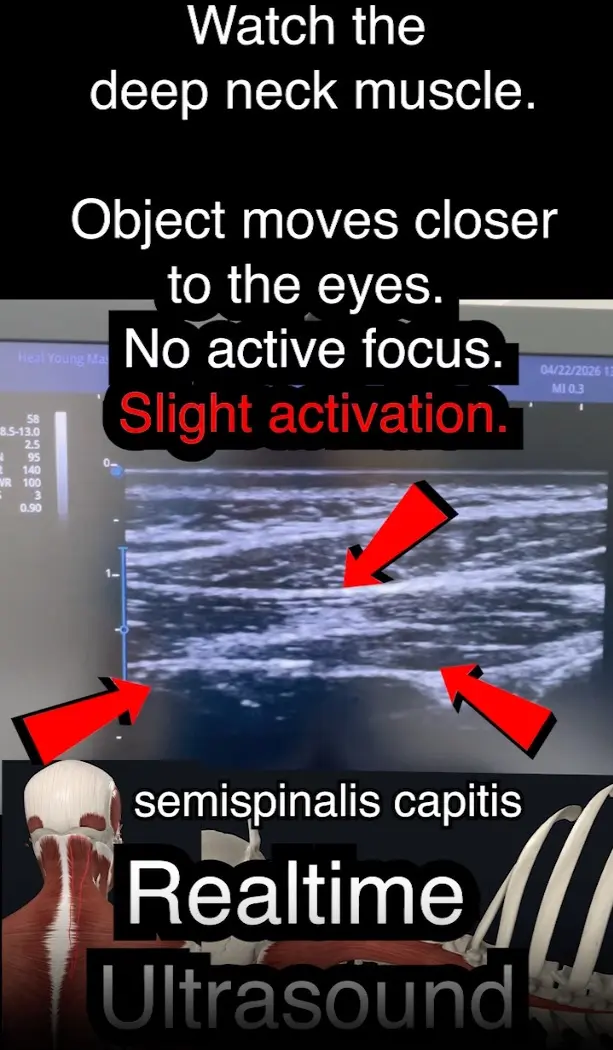
Real-time ultrasound
Shows muscle and fascia moving in real time, used when observation alone doesn’t explain the presentation. See it in action →
Motion analysis
Tracks compensation patterns under load, and whether the same pattern repeats across repetitions. Learn more →
Movement assessment within exercise science scope (ESSA AES #17005) · Footage shared with client consent · Educational content only · Individual results vary
“Where you feel it is often not where the problem lives. If standard care hasn’t fully worked, your assessment needs to start with how you move — not just the sore spot.”
What this means for you
Your neck may not be
the problem.
It may be the strategy.
Real-time ultrasound lets us see how the tissue moves — often well away from where you feel it. Treatment then works with the pattern, not just the sore spot.
Cervical tissue assessment · Real-time ultrasound · Heal Young Massage, Varsity Lakes
Your sessions
Dynamic Myofascial Release & The H.E.A.L. Method
Your sessions use Dynamic Myofascial Release (DMFR) and the H.E.A.L. Method — an assessment-led framework built to find what’s contributing to your pain, not just treat the site.
Every session focuses on how you move, not just where it hurts. See what to expect in a session →
Where are you right now?
Most people land somewhere between Stage 1 and Stage 3. You don’t need to reach Stage 5 — you just need to know where you are now, and what’s realistic from here. Pick the stage that sounds like you.
Your presentation guides every session — not a one-size-fits-all protocol.
When you need more than symptom relief
Your body deserves to be taken seriously — especially when care hasn’t worked.
If you’ve tried treatment and still aren’t where you need to be, you need someone who looks past the obvious site of pain. The clinical approach here was shaped by 20+ years and 25,000+ sessions of remedial massage Gold Coast and NT — including complex cases where standard care fell short.
Read the clinical background behind this practice →
Hill Yang · Remedial Massage Gold Coast · Exercise Scientist · RMT
Professional Recognition
Common presentations
Common presentations seen at this remedial massage Gold Coast clinic — does any of this sound familiar?
What to expect
Common questions
No. Remedial massage is a self-referred service, so you can book directly online without seeing a GP first. If you’re already working with a GP, physiotherapist or exercise physiologist, that care can continue alongside — a written summary can be provided on request so everyone is working from the same information.
Yes. HICAPS is available on site, so eligible health fund rebates are processed at the time of your appointment and you pay only the gap. Rebate amounts vary by fund and level of cover — checking your remedial massage extras limit with your fund beforehand is worthwhile. See accepted health funds.
Your health history is completed online before you arrive, so there’s no paperwork on the day. The session opens with structured assessment — history, movement observation and palpation — before any hands-on work begins. Where observation alone isn’t enough, objective measurement may be used: force plate testing, real-time ultrasound or motion analysis. Treatment is then matched to what the assessment finds. See what to expect.
Dynamic Myofascial Release is a movement-integrated myofascial technique developed by Hill Yang in 2015 while completing a Diploma of Remedial Massage at the Massage School of Queensland. Where conventional myofascial release is applied to a still body, DMFR applies the technique while the client moves actively through range — the reasoning being that fascia behaves differently under load than at rest. It has been practised across approximately 17,000 sessions since. Read the background.
The main difference is what happens before the hands-on work. Sessions here are assessment-led: movement is observed and, where useful, measured, so treatment is directed at the pattern producing the symptom rather than only the area where it’s felt. Hill Yang is dual-qualified as an ESSA Accredited Exercise Scientist and a Remedial Massage Therapist, which is what makes exercise-science assessment part of a massage consultation.
Yes. Consultations are available in both English and Mandarin, including assessment findings and any home strategies discussed. 提供中文(國語)諮詢服務,包含評估說明與居家建議。中文介紹頁面。
The clinic is at 21 Meridien Avenue, Varsity Lakes, with free street parking. It sits within roughly ten minutes of Robina, Burleigh Heads, Burleigh Waters, Mudgeeraba and Reedy Creek, and around twenty minutes from Coolangatta and Tweed Heads. All appointments are booked online.
Ready to find out
what’s actually going on?
Book online at Varsity Lakes — centrally located for clients from Burleigh Heads, Burleigh Waters, Robina, Mudgeeraba, Reedy Creek, Palm Beach and Coolangatta. Or start with the $50 online assessment if you’re not sure where you fit yet.
All appointments booked online · Email only for booking form help
Educational content only. Not medical advice. Individual results vary. Hill Yang is an ESSA Accredited Exercise Scientist (AES #17005) and Remedial Massage Therapist (MMA #031045). Always consult a qualified health professional for personal health concerns.