
Dynamic Myofascial Release:
The Research Behind the Technique
Research Overview
“In 2015, I developed Dynamic Myofascial Release (DMFR) to solve a clinical problem: treatments applied to a static resting body often fade when the body returns to dynamic functional movement. The solution was applying myofascial release simultaneously with active functional weight-bearing mechanics.”
— Hill Yang, Founder of Heal Young Massage
Dynamic Myofascial Release (DMFR) was developed in 2015 by Hill Yang during clinical placements at the Massage School of Queensland. The technique was designed to bridge a persistent gap in standard clinical treatments: table-based, static myofascial release often provides immediate relief in a resting position, but restrictions can return once the body resumes dynamic, active movement under functional load. See also how DMFR was developed clinically and the broader fascia education hub.
The principle of specificity of adaptation is foundational to training theory: the body adapts to the specific demands placed on it. If the goal is to change how fascia behaves under functional load, treating it only in a passive, unloaded state may not be the most efficient path.
The clinical question was simple: what happens if you apply myofascial release while the patient is actively moving?
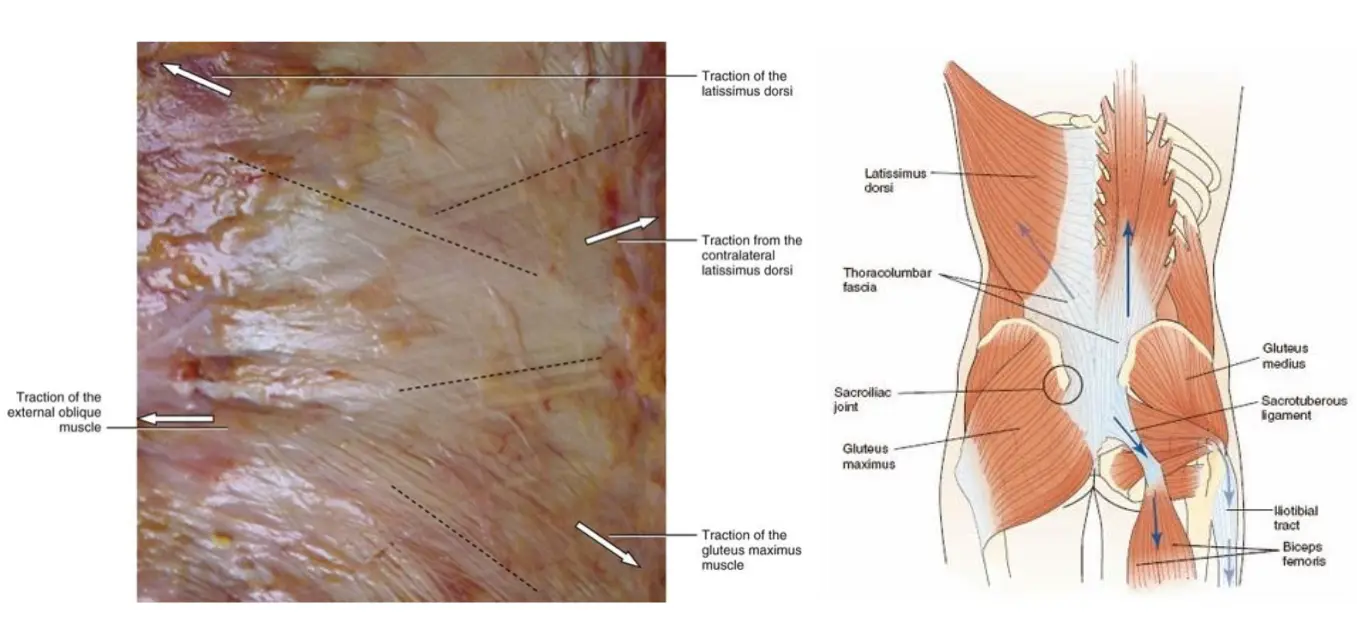
Designing the Research
The method involves the patient standing and performing active functional movements—specifically, reaching movements toward numbered targets placed on the ground around them—while the therapist simultaneously applies myofascial release to the affected tissue. Today this sits within an assessment-led treatment framework at Heal Young Massage.
The DMFR Protocol
Functional Positioning
The patient stands weight-bearing, replicating the specific mechanical loads and postural positions where chronic pain occurs.
Active Target Movement
The nervous system and fascial lines are activated as the patient actively reaches for designated functional targets.
Simultaneous Release
Myofascial tension is released under active muscular load, embedding the new tissue tolerance deeply into the nervous system.
This movement component achieves two things simultaneously:
It reveals restriction in real time. As you reach toward different targets, the therapist can feel the fascial system under load—exactly where it catches, pulls, or resists—rather than palpating static tissue and theorising where the restriction might be.
It recruits the muscle during treatment. Research in biomechanics and exercise science shows that activated muscle absorbs significantly more energy than passive muscle, and is capable of tolerating greater mechanical input. Applying myofascial release to tissue under active load means the release occurs at the tension level present during actual function.
A third mechanism relates to the nervous system. Passive myofascial release naturally induces a calming, parasympathetic response—which is therapeutically useful, but means the nervous system is not in the same state it will be in when you stand up and move through your day. DMFR maintains nervous system engagement throughout treatment, supporting better transfer of the release into functional movement.
The Study
The formal research was submitted in September 2015 under the title: “A Better Way to Ease the Pain for The Lower Back: Dynamic Myofascial Release.”
Participants: Six adults presenting with chronic lower back pain—a mix of men and women, across different ages and pain histories. The study was conducted at the Massage School of Queensland under clinical supervision.
Method: Each participant received a DMFR treatment session. Pain was recorded before treatment, immediately after, and then at one week, two weeks, and three weeks post-treatment using a 0–10 pain scale.
Clinical Findings (2015 Study)
Average pain scores reported by six participants presenting with chronic lower back pain following a single DMFR treatment session. Educational context only — a small student study, not a randomised controlled trial. Individual results vary.
Treatment Pain Reduction Timeline
| Timeline | Average Pain Score (0-10) | Pain Reduction from Baseline |
|---|---|---|
| Before Treatment | 6.33 / 10 | — |
| Immediately After | 1.17 / 10 | 82.1% Reduction |
| One Week Later | 1.17 / 10 | 82.9% Reduction |
| Two Weeks Later | 1.50 / 10 | 78.6% Reduction |
| Three Weeks Later | 2.00 / 10 | 71.4% Reduction |
These were early results with a small sample. The research was a student study, not a randomised controlled trial. It is presented not as definitive clinical evidence of universal efficacy, but as documentation that the technique has a rationale, and produced measurable results from the first time it was formally tested.
The full research paper includes 73 references, drawing on work by Travell and Simons (myofascial trigger point theory), John F. Barnes (myofascial release principles), Robert Schleip and Amanda Baker (Fascia in Sport and Movement), and Eyal Lederman (neuromuscular approaches in manual therapy).
What the Evidence Behind Myofascial Release Shows
Broader research on passive, table-based myofascial release shows a reasonable evidence base for pain reduction and range of motion improvement, particularly for chronic lower back and neck pain. The mechanisms are primarily neurological: sustained pressure on fascial tissue stimulates mechanoreceptors, which signal the central nervous system to reduce local muscle tone and allow tissue reorganisation.
The evidence for dynamic or movement-integrated myofascial approaches is a newer area of application. What the 2015 paper contributed was formal documentation of a specific combined approach: simultaneous active functional movement and myofascial release, applied to a standing patient, grounded in an explicit theoretical framework.
What 11 Years of Practice Has Added
While the 2015 research provided the initial quantitative proof—showing an 82.1% average pain reduction in that small cohort—a decade of daily practice across different environments provided qualitative refinement. With 11,832 clinical sessions delivered in Alice Springs alone, and more than 25,000 sessions in total using the DMFR framework, this technique has transitioned from a researched theory into a precise, field-tested clinical tool applied in remedial massage sessions at Varsity Lakes.
Between December 2019 and December 2025, Hill Yang delivered 11,832 sessions as a sole practitioner in Alice Springs—the Northern Territory’s most remote major centre. Working in that environment, with clients who often had limited access to other health services, required refining DMFR significantly:
- Adapting treatment patterns for clients who cannot perform a standing reach pattern.
- Modifying protocols for Central Australia’s extreme climate, where dehydration directly affects fascial tissue quality.
- Extending DMFR beyond the lower back to address cervical and thoracic restriction, shoulder dysfunction, and hip/lateral chain involvement.
- Refining the movement component across hundreds of variations tailored to specific functional demands, from desk workers to endurance athletes.
Clinical Case Study — The Experienced Musician
A professional cellist presented with persistent shoulder and arm pain affecting her ability to play. Despite decades of experience and other treatments, the discomfort remained. Observation of her playing and analysis of elbow positioning revealed a movement strategy that placed excessive mechanical load on the shoulder. By exploring a modified positioning strategy, her shoulder mechanics improved and pain was resolved. This illustrates what movement screening reveals: not right or wrong postures, but how restrictions force the body into movement strategies that eventually cause pain.
Where This Is Heading
The move to the Gold Coast represents a focus on integrating DMFR with objective performance assessment. Using VALD ForceDecks force plate technology, force output, asymmetry, and movement quality are measured in real time.
A fascial restriction that reduces ground reaction force symmetry by 12% is a performance problem before it becomes a pain problem. Treating it proactively, under functional load, using DMFR, is a logical application of this clinical framework.
Applying This to Your Treatment
The pain reduction data from the 2015 clinical study forms the foundation of this approach. Today, DMFR techniques refined since that study are combined with movement assessment—and where indicated, motion tracking or force plate data—to tailor sessions to what your body actually needs. If you are dealing with stubborn lower back pain and want to know if this approach is right for you, start with an in-clinic assessment.
Ready to experience Dynamic Myofascial Release?
All treatments begin with a full clinical assessment so that your session is tailored to what your body actually needs, not a generic routine.
Book In-Clinic Assessment Explore assessment-led treatment →Educational content only. Not medical advice. Individual results vary. The 2015 study involved six participants and was not a randomised controlled trial. Hill Yang is an ESSA Accredited Exercise Scientist (#17005) and Remedial Massage Therapist (MMA #031045). Always consult a qualified health professional for personal health concerns.