
When All the Tests
Come Back Clear
What objective force plate assessment reveals about neuromuscular function that imaging, manual testing, and clinical observation alone cannot access — and why it changes the way we approach persistent lower limb presentations.
About this article: This post discusses an educational force plate case study based on de-identified assessment data from Heal Young Massage, Varsity Lakes. No personal information is included. All findings are presented for educational purposes only and do not constitute medical advice or imply guaranteed outcomes. Individual results vary. This post covers Sessions 1 and 2. The complete four-session dataset — including loaded squat data and neuromotor reorganisation stages — is documented in the extended force plate case study (S1–S4) →
One of the most common — and most frustrating — presentations I see at the clinic involves someone who has done everything right. They have seen multiple specialists. They have completed all the imaging. They have followed every prescribed rehabilitation programme. And yet they are still in pain, still struggling, and still unable to return to the activities they love.
The clinical puzzle is this: when all the tests come back clear, and when all the recommended treatments have been attempted without lasting improvement, what are we missing?
In my practice, I use the VALD ForceDecks force plate system alongside hands-on clinical assessment to explore one specific possibility: that the problem is not structural — it is neuromuscular. And neuromuscular dysfunction of a particular kind is, in most cases, completely invisible to standard diagnostic tools.
“The clinical eye identifies the pattern. Objective tools validate it, quantify it, and make it trackable over time.”
The Clinical Picture
In the de-identified case I am discussing here, the client presented with a long-standing lower limb complaint following a sports injury approximately 16 months prior to assessment. Over that period, they had been seen by multiple sports medicine physicians, completed extensive diagnostic imaging, and undertaken structured rehabilitation programmes across multiple practitioners.
The consistent finding from each of those practitioners: the imaging was clear, the structural findings did not fully explain the symptoms, and standard progressive loading had not produced durable improvement. In fact, the client consistently reported significant symptom exacerbation following exercise — not during the activity, but in the 12 to 24 hours afterwards, often lasting several days.
On initial assessment, I observed a clear loading asymmetry during gait and during functional movement. The affected limb showed reduced contribution and altered mechanics. When I asked the client to demonstrate the rehabilitation movements they had been prescribed, my immediate observation was that the neuromuscular state of the limb did not appear consistent with the demands of those exercises.
This is precisely where force plate assessment becomes clinically valuable — not to find what the eye cannot see, but to measure and document what the clinical eye has already identified.
What the Force Plate Data Showed
The initial assessment used the VALD ForceDecks Squat Test (SQT) protocol, which measures bilateral force output, movement symmetry, squat depth, and neuromuscular control metrics across multiple repetitions.
Three metrics were particularly clinically informative.
① Eccentric Deceleration Rate of Force Development (RFD)
This metric measures how quickly the neuromuscular system can generate braking force during the lowering phase of a squat — the eccentric phase in which the body must absorb and control load rather than produce it. When this capacity is impaired or highly variable, the joint absorbs compressive forces it would otherwise be protected from. The clinical consequence is often delayed onset pain: soreness that appears 12–24 hours post-exercise, not during it.
② Bilateral Asymmetry
Force plates measure the relative contribution of each limb across every millisecond of movement. Consistent asymmetry — even on repetitions that appear technically acceptable to observe — indicates the nervous system is offloading one side. This is a hallmark pattern of arthrogenic muscle inhibition (AMI): a well-documented neurological reflex in which joint afferents suppress surrounding musculature, often persisting long after the original tissue injury has healed.
③ Coefficient of Variation (CoV)
CoV measures how consistently force is produced across repetitions. High CoV — even when average force values appear acceptable — indicates unpredictable neuromuscular output. In presentations involving inhibition or guarding, CoV is often a more sensitive indicator of dysfunction than average values alone, because it captures the variability that averages conceal.
Baseline Assessment Data
The initial force plate assessment produced the following findings across six repetitions.
The most clinically significant finding at baseline was the eccentric deceleration RFD. An average of 126 N/s with a CoV of 877% indicates that braking capacity was not only very low on average, but producing near-zero output on individual repetitions with no predictable pattern. Two of six repetitions produced RFD values under 20 N/s — essentially no braking capacity at all.
This directly maps to the client’s reported experience: exercises that did not feel painful at the time, followed by days of significant soreness. The joint was absorbing unprotected compressive load on each repetition where the braking system was not functioning.
Progress Across Two Sessions
The table below summarises the key force plate metrics across the baseline assessment, the same-day post-session assessment, and the second session (with warm-up repetitions excluded as artefact). For the complete progression across all four sessions — including the loaded squat data — see the full force plate case study.
| Metric | Baseline | Session 1 After | Session 2 Adj. | Change |
|---|---|---|---|---|
| Avg Peak Force | 702 N | 811 N | 889 N | +27% |
| Ecc Dec RFD Avg | 126 N/s | 571 N/s | 828 N/s | 6.6× increase |
| RFD CoV | 877% | 43% | 17% | ↓98% |
| Squat Depth Avg | 21.8 cm | 30.5 cm | 33.2 cm | +52% |
| Peak Force Asymmetry | 8.7% L | 3.2% L | 5.0% L | ↓43% |
| Depth CoV | 23% | 8.4% | 6.5% | ↓72% |
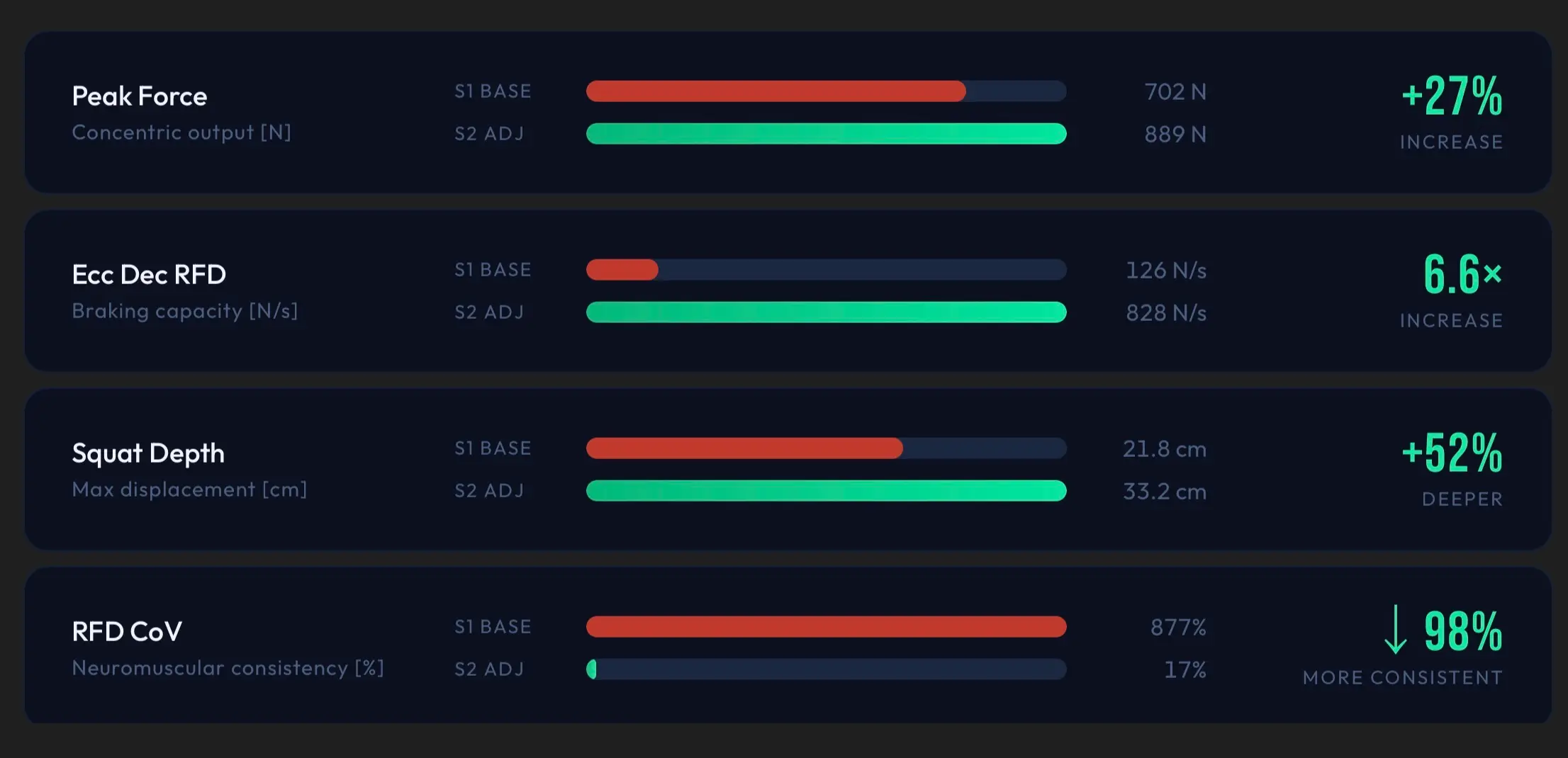
A note on the Session 2 adjustment: the first two repetitions of Session 2 were identified as a warm-up artefact (producing 676 N and 726 N peak force respectively, versus a stable plateau of 834–925 N from repetition three onwards). Excluding these two repetitions gives a more accurate representation of the client’s working neuromuscular capacity at that session.
What the Trend Tells Us
Three data points across two sessions are not sufficient to draw firm conclusions. However, the direction of change across all key metrics is consistent and the pattern is clinically meaningful.
The most significant finding is not the average RFD improvement — it is the CoV reduction. A drop from 877% to 17% represents a shift from a nervous system producing unpredictable, unreliable braking output to one producing consistent, repeatable output across repetitions. This is the mechanism most directly relevant to the client’s previous pattern of exercise-related symptom exacerbation.
The bilateral asymmetry data also shows a meaningful pattern. The initial consistent left-side deficit — present across all force metrics — has reduced substantially and is now within a range that would be considered clinically acceptable. The session 2 data shows the asymmetry shifting slightly in direction across some metrics, which is consistent with a transitional pattern as the previously inhibited limb continues to recalibrate.
The squat depth finding is worth noting specifically because it is a directly observable outcome. The client’s functional range of motion increased 52% from baseline to the session 2 adjusted measurement, with a CoV reduction from 23% to 6.5% — indicating not just a deeper squat, but a far more consistent and controlled one.
Clinical Takeaways
What This Case Illustrates
The following observations are drawn from this case for educational purposes. They are not generalisable claims about outcomes.
Neuromuscular inhibition can persist after structural healing
Arthrogenic muscle inhibition is well documented in the research literature. It is driven by joint afferent signals and does not resolve automatically when tissue heals. Imaging cannot detect it.
Variability is as important as average values
Coefficient of variation in eccentric metrics may be a more sensitive early indicator of neuromuscular dysfunction than average force output. A high CoV can be clinically significant even when average values appear reasonable.
Load prescription without RFD assessment carries risk
Progressive loading applied to a limb with impaired eccentric deceleration capacity may reinforce compensatory patterns and contribute to ongoing symptom cycles, regardless of how well the exercise is prescribed.
Clinical observation and objective measurement are complementary
The clinical eye identifies the pattern. Force plate technology quantifies it, documents it, and makes it trackable — enabling more precise communication with other practitioners and more informed loading decisions over time.
About This Approach
How We Use Force Plate Assessment at Heal Young Massage
The VALD ForceDecks system is used in elite sport and high-performance settings to objectively quantify lower limb neuromuscular function. At Heal Young Massage, we use it as part of a comprehensive clinical assessment framework — not as a standalone tool, but as an additional lens that validates and documents clinical observations.
Our approach is grounded in the principle that the practitioner’s clinical eye is the primary instrument. Technology serves to make what is observed measurable, trackable, and communicable — particularly when working as part of a multidisciplinary team supporting a client’s rehabilitation or return to activity.
This is particularly relevant for clients who present with persistent symptoms where standard diagnostic pathways have not identified a clear structural explanation. In these presentations, objective neuromuscular assessment may offer an additional perspective that supports more informed decision-making about load management and rehabilitation progression. You can read how the full picture developed across all four sessions in the extended force plate case study.
Hill Yang is an ESSA Accredited Exercise Scientist (AES #17005) and Remedial Massage Therapist (MMA #031045) with over 20 years of clinical experience and more than 25,000 sessions.
Heal Young Massage · Varsity Lakes
Curious About Objective Movement Assessment?
If you’re managing a persistent lower limb presentation or want to understand how your movement patterns look under objective assessment, we’d love to hear from you.
Educational content only. Not medical advice. Individual results vary. All data presented is de-identified and used for educational purposes only. Always consult a qualified health professional for personal health concerns.

About the Author
Hill Yang
Hill has more than 20 years of clinical experience and over 25,000 hands-on sessions. He combines remedial massage with movement assessment, including force plate and motion-capture tools, to understand how load moves through the body. Hill was part of the medical team at the 2018 Commonwealth Games and is a finalist in the 2026 Australian Small Business Champion Awards (Health Improvement Services). He practises at Heal Young Massage in Varsity Lakes, Gold Coast, and offers sessions in English and Mandarin.