When movement feels stuck
and nothing seems to release it.
You stretch, foam roll, try massage and rest — but something won’t let go. That stubborn restriction may not be muscle tension at all. It may be your fascia. Specialist assessment at Varsity Lakes, serving clients across the Gold Coast.
Persistent tightness that doesn’t respond to standard care often has a different source. A fascial restriction assessment looks beyond the painful site to identify what may be contributing — and explores approaches that a general massage intake typically doesn’t reach. Located at 21 Meridien Avenue, Varsity Lakes, this practice supports clients from across the Gold Coast, including Robina, Burleigh Heads, Miami, Mudgeeraba, and surrounding areas.
Understanding fascia
What is
fascial restriction?
Fascia is the continuous web of connective tissue that wraps around every muscle, bone, nerve, and organ in your body — the three-dimensional scaffolding that holds your structure together.
When fascia is healthy, it glides and adapts to movement. But after injury, surgery, repetitive strain, or prolonged postural stress, fascia can lose its hydration and flexibility. It becomes restricted, adhered, or densified.
Unlike muscle tension, which often responds to stretching or standard massage, fascial restrictions:
- Create a pulling sensation rather than a discrete “knot”
- May produce symptoms distant from the restriction site — for example, a neck restriction contributing to shoulder presentation
- Don’t release with general pressure — they require specific direction and technique
- Often persist despite other areas feeling “loose”
Recognising the presentation
Common signs of
fascial restriction.
| What you may notice | What it often feels like |
|---|---|
| “Stuck” sensation | A feeling that something needs to “unwind” or let go — not a typical knot |
| Referred symptoms | Discomfort in one area that seems connected to restriction elsewhere in the body |
| Range that won’t improve | Stretching produces no lasting change regardless of how consistently it’s done |
| Asymmetrical movement | One side of the body moves differently to the other — sometimes subtly, sometimes clearly |
| Pulling or tugging internally | A tethered sensation when reaching or bending — as though something is limiting from inside |
What the assessment addresses
Why a standard session may not
reach a fascial restriction.
Most practitioners work with what they can feel at the surface. If a restriction lies in a deeper fascial layer, or if it refers symptoms from a distant site, it can go unaddressed in a standard intake.
Assessing and working with fascial restriction requires:
- Fascial anatomy and sling system knowledge Understanding how tension transfers through continuous chains — not just isolated muscles.
- Specific palpation skills The ability to differentiate tissue density, glide, and direction of restriction — not just locate tenderness.
- Symptom referral mapping Recognising when the painful site is an endpoint, not the source — and tracing the chain back to its origin.
- Precise technique application Techniques applied with appropriate direction, depth, and duration — not general pressure.
This is what a dedicated fascial restriction assessment offers beyond a standard massage intake.
Clinical observation
How fascial restriction contributes to back presentations —
seven clinical examples.
In clinical practice, clients regularly present with lower back discomfort that has a contributing source elsewhere in the body. Hill documented a single day where seven consecutive clients presented with lower back presentations — each from a completely different origin.
Clinical reflection
Why Your Lower Back Presentation Keeps Coming Back
 Seven contributing sources observed in seven consecutive lower back presentations — none originating in the lower back itself.
Here is what those seven cases revealed:
| # | Source of restriction | How it contributed to the back presentation |
|---|---|---|
| 1 | Ankle dysfunction | Faulty gait mechanics required the lumbar spine to absorb force that the ankle and hip should have managed. No direct back work was needed — assessment focused on the ankle. |
| 2 | Hamstring overactivation | Chronically braced hamstrings transmitted tension directly into the lumbar fascia, keeping the lower back under load even at rest. |
| 3 | Psoas complex | Chronic hip flexor tension limited hip extension and altered lumbar positioning, contributing to low-grade discomfort during movement. |
| 4 | Old neck injury | Cervical restriction altered thoracic mechanics, placing chronic demand on the lumbar region. The back itself was not the source. |
| 5 | Shoulder dysfunction | Left shoulder restriction reorganised movement through the entire upper body, eventually creating compensatory demand in the lower back. |
| 6 | Breathing pattern dysfunction | Compromised respiratory mechanics triggered bracing through the thoracolumbar fascia as back muscles were recruited to stabilise what the diaphragm could not. |
| 7 | Abdominal fascial restriction | Severe gastrointestinal infection had left fascial restriction around the ascending colon. The lower back was guarding, not injured. Following release of the abdominal restriction, lumbar discomfort improved markedly in the same session. |
The common thread: in every case, the lower back was the endpoint of the chain — not the source. The discomfort was real, but the contributing factor lay in fascial restriction elsewhere. This is why targeting the painful site alone often provides only temporary relief, and why a whole-body fascial restriction assessment is often the missing step in persistent back presentations.
The assessment process
What a fascial restriction
assessment involves.
Every first appointment begins with assessment before any hands-on work. For a fascial restriction assessment, this includes five structured components.
Comprehensive movement screening
Hill doesn’t just ask where it hurts — he watches how you move. Your movement patterns reveal the strategies your body has developed to work around restriction, often without conscious awareness.
Walking assessment
Observing the entire kinetic chain — head and neck rotation, shoulder and arm swing, trunk and spinal rotation, hip and pelvis weight shift, knee and ankle load symmetry, and breathing pattern. Asymmetries and compensations reveal themselves before treatment begins.
Stair assessment (where relevant)
Ascending and descending stairs loads the body differently to walking and often exposes hip stability, knee tracking, and balance compensations not visible on flat ground.
Running gait analysis (athletes)
For runners and athletes, Hill assesses running form as it relates to the presentation — loading strategies under demand, force absorption patterns, speed-dependent changes in movement quality, and efficiency losses that may limit performance.
Task-specific assessment
Truly individualised assessment. You may bring video of your golf swing, tennis serve, or gym movements that provoke symptoms. Hill observes where tension accumulates, where movement stops, and what compensations emerge under demand.
Case study — educational
The cellist with 40 years of experience
A professional cellist presented with persistent shoulder and arm discomfort affecting her ability to play. Despite decades of experience, the presentation remained. Hill observed her playing, noted her elbow position, and asked her to show video of professional cellists she admired. The difference in elbow position was observable — a different movement strategy that placed less demand on the shoulder complex. She explored that position. The shoulder presentation improved significantly within that session.
This is what movement screening reveals: not right or wrong, but what the body is doing, what’s possible, and where restriction may be driving strategies that eventually create discomfort — even after 40 years of expertise.
Bilateral fascial palpation
Hill assesses tissue density, glide, and restriction on both sides of your body for comparison. This identifies not just that a restriction exists, but its depth, direction, and relationship to surrounding structures — allowing for a precision-matched approach rather than a generalised one.
“He doesn’t just focus on where it hurts — he looks at how your whole body moves and works together. More than once I’ve gone in convinced my back was the issue, and he’s identified a different source entirely.”
— Elisa GoldbergKinetic chain tracing
Fascia doesn’t work in isolation. A restriction in the thoracic spine may be pulling on the cervical spine. A limitation in the hamstring may trace back to the lumbar fascia. Hill follows the chain to identify the contributing source, not just the presenting site.
This is particularly relevant for presentations that seem unrelated — shoulder discomfort with hip restriction on the same side, or recurring lower back issues with a history of ankle injury.
Functional load testing (where indicated)
Using VALD ForceDecks technology, Hill can objectively measure force asymmetry and variability under load. This reveals how restriction affects movement when demand increases — often the moment where symptoms become apparent in active clients.
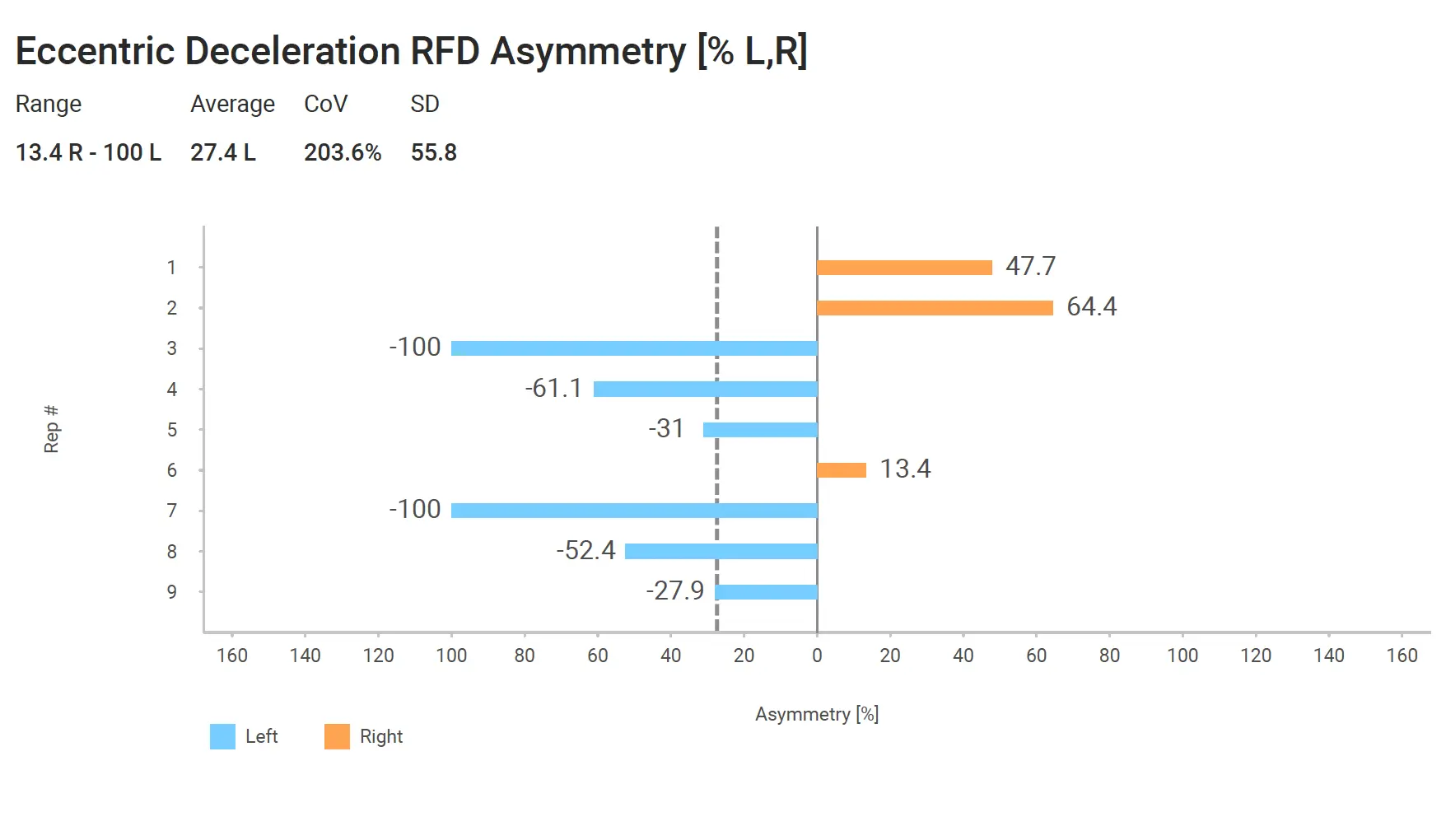 VALD ForceDecks squat assessment — eccentric deceleration variability (CoV 203.6%) revealing inconsistent bilateral load absorption. Objective measurement guides clinical decisions beyond symptom reporting alone.
Respiratory and postural assessment
Fascia connects directly to the diaphragm. As Case 6 from the seven cases illustrates, chronic breathing patterns can create or maintain restriction through the thoracolumbar fascia. Hill assesses how you breathe and how it may be affecting your fascial system — an element that is frequently overlooked in standard practice.
The approach
What happens
after assessment.
Unlike a standard session where a single technique is applied throughout, the approach at Heal Young Massage is assessment-led and technique-matched. Based on findings, work may include:
- Myofascial release Sustained, directional pressure to elongate restricted connective tissue — applied with appropriate depth and direction, not general compression.
- Fascial unwinding Gentle guidance of tissue as it progresses through restriction — following the body’s response rather than applying a predetermined technique.
- Instrument-assisted techniques Precise tools for more adherent or localised restrictions, particularly around scar tissue or post-surgical areas.
- Movement retraining Exercises to support the changes achieved in session and help prevent the restriction re-establishing under habitual load.
- Self-management tools Specific techniques using foam roller, S-ball, or targeted movement that you can apply at home between sessions.
The aim is not just to address the restriction, but to restore glide, improve load tolerance, and reintegrate the area into normal movement patterns.
Is this right for you?
This assessment may suit
people who:
The first appointment is always assessment before any hands-on work begins. Your history is taken, movement is observed, and a session plan is built based on what the assessment actually finds — not a pre-determined template.
What to expect
Booking your fascial
restriction assessment.
Location
21 Meridien Avenue
Varsity Lakes QLD 4227
By appointment only
Duration
60 minutes
Includes full fascial assessment, movement screening, hands-on work, and take-home strategies
Health fund rebates
Rebates may apply — check with your provider regarding remedial massage coverage
Clients attend from
Robina, Burleigh Heads, Mudgeeraba, Merrimac, Miami, Palm Beach, and surrounding Gold Coast areas
Common questions
Fascial restriction —
frequently asked.
How is fascial restriction different from a muscle knot?
Muscle knots are localised hyperirritable spots within a muscle. Fascial restriction involves the connective tissue network itself — it’s broader, often deeper, and creates a pulling or tethering sensation rather than a discrete nodule. The two can co-exist, but the assessment and approach differ.
Can fascial restriction contribute to discomfort in a different part of the body?
Yes. As the seven cases illustrate, fascia forms continuous chains through the body. A restriction in the calf can refer tension through the hamstring, pelvic floor, and lumbar spine. This is why addressing only the painful site often provides limited sustained relief.
Is myofascial release uncomfortable?
It can be, though it shouldn’t be unbearable. The sensation is often described as a “productive stretch” — a purposeful feeling rather than sharp discomfort. Hill always adjusts if intensity reaches a level that could compromise recovery.
How many sessions are typically needed?
This varies considerably depending on the nature, duration, and complexity of the restriction. Some clients notice meaningful change within the first session. Presentations involving chronic or post-surgical changes typically require more sessions to progress. Your assessment will include an honest discussion about what to expect for your specific situation.
Do you accept referrals from other practitioners?
Yes. Hill works collaboratively with GPs, physiotherapists, osteopaths, and exercise physiologists. If you’re currently under another practitioner’s care, he is happy to coordinate with them as appropriate.
About the practitioner
Hill Yang —
RMT & Exercise Scientist.
Hill Yang is a remedial massage therapist and ESSA Accredited Exercise Scientist with more than 20 years of clinical experience and 25,000+ sessions delivered. His approach combines fascial anatomy, movement science, and objective measurement to identify what may be contributing to a presentation — not just manage the site of discomfort.
Government recognition: NT Chief Minister (2025) · QLD Premier (2025)
Award: 2026 Australian Small Business Champion Awards — Finalist, Health Improvement Services
Ready to find out
what’s holding you back?
If you recognise your situation in any of the seven cases, or if you’ve been living with a restriction that doesn’t resolve, a fascial assessment may be the missing step.
Explore further
Educational content only. Not medical advice. Individual results vary. The clinical observations and case examples presented are de-identified and published for educational purposes. Hill Yang is an ESSA Accredited Exercise Scientist (AES #17005) and Remedial Massage Therapist (MMA #031045). Always consult a qualified health professional for personal health concerns.