Sciatica & Leg Nerve-Type Pain · Varsity Lakes, Gold Coast
Sciatica Gold Coast
Assessed, Not Assumed
Pain, tingling or nerve-type sensations running from your lower back or glute down the leg can come from a number of different contributing factors. Hill Yang combines objective movement assessment with hands-on Dynamic Myofascial Release to explore what’s going on — not just where it’s felt.
Sciatica Gold Coast: sciatica-type leg pain is a general term for pain, tingling, numbness, or nerve-type sensations felt along the lower back, glute, and down the leg. It describes a pattern of symptoms, not a diagnosis. At Heal Young Massage in Varsity Lakes, Hill Yang uses assessment-led, movement-based massage — supported by objective tools like VALD ForceDecks and diagnostic ultrasound — to explore the contributing factors behind those symptoms, rather than working on the leg alone.
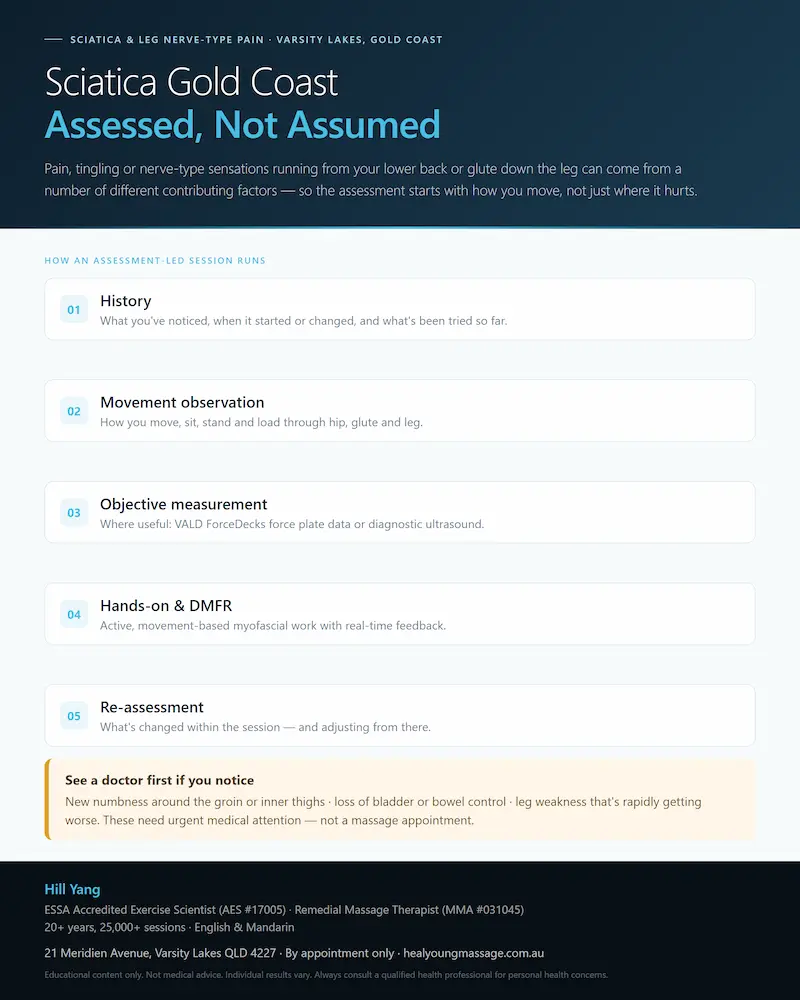
When to see a doctor first: if you notice new numbness around the groin or inner thighs, loss of bladder or bowel control, or leg weakness that’s rapidly getting worse, these can be signs that need urgent medical attention. Please see your GP or go to the nearest emergency department rather than booking a massage appointment.
Does this sound like you?
Common ways people describe it
- Pain, tingling, or numbness that seems to travel from your lower back or glute down the back of one leg
- Leg symptoms that come and go with sitting, driving, or standing for long periods
- Hip or glute tightness alongside leg discomfort that hasn’t settled with stretching on its own
- You’ve tried general massage or home stretching and the leg symptoms keep returning
- Previous care addressed your lower back, but the leg symptoms are still hanging around
- Symptoms that seem to shift or move around, rather than stay in one fixed spot
Understanding the symptoms
Sciatica Gold Coast: what the symptoms may represent
“Sciatica” describes where symptoms are felt — commonly the lower back, glute, and down the back of the leg, along the path of the sciatic nerve. It isn’t a diagnosis by itself, and a number of different structures and movement patterns can produce a similar pattern of symptoms.
As a dual-qualified ESSA Accredited Exercise Scientist and Remedial Massage Therapist, Hill Yang’s approach looks at how your lower back, hip, glute, and leg are moving and loading together, using observation and, where appropriate, objective measurement, to explore what factors may be contributing to what you’re feeling — before any hands-on work begins.
The approach
Why where it hurts is rarely where it starts
General massage often focuses on wherever the pain is felt — but the leg is frequently where a pattern shows up, not necessarily where it begins. Hill Yang’s clinical framework looks at the difference between a stable movement pattern your body has adapted to over time, and a genuine imbalance that may be contributing to ongoing symptoms.
A static assessment — looking at posture or simply where something hurts — is only part of the picture. Watching how you actually move, load, and recover under real conditions gives a fuller view of what might be contributing to your symptoms, which is why an assessment-led first session is the starting point here, rather than jumping straight to hands-on work.
Sciatica movement assessment
How an assessment-led session runs
History
What you’ve noticed, when it started or changed, and what’s been tried so far.
Movement observation
Watching how you move, sit, stand, and load through your hip, glute, and leg.
Objective measurement
Where useful, force plate data or diagnostic ultrasound imaging to support what’s observed.
Hands-on & DMFR
Active, movement-based myofascial work with real-time feedback — not passive massage alone.
Re-assessment
Checking in on what’s changed within the session, so the approach can be adjusted as you go.
Objective assessment tools
Measurement, when it’s useful
VALD ForceDecks
Force plate technology used to look at load distribution and side-to-side differences during movement, offering an objective layer alongside hands-on assessment — used within Hill’s ESSA Accredited Exercise Scientist scope (AES #17005).
Diagnostic Ultrasound
Musculoskeletal ultrasound imaging may be used, where appropriate, to support what’s being observed and felt. This is a supportive assessment tool and does not constitute a medical diagnostic report.
A worked example
What an assessment-led session can look like
The scenario below is a general, illustrative walk-through of how this kind of assessment can unfold — it’s included to explain the approach, not as a guarantee of what any individual session will find or achieve. It isn’t a description of any specific client.
Someone presents with a sudden flare of gluteal pain that started the day before, on a background of intermittent right-sided gluteal and leg symptoms over the past year or two. They can’t get up from a chair without pushing down through their hands or knees, walking is guarded for the first few steps before it eases, and turning through the trunk to one side is sharply restricted and sore.
On assessment, the leg itself tests comfortably on its own — straight leg and knee movement are pain-free. The picture instead points toward the lower back and pelvis: one side of the pelvis is restricted in a way that appears to be referring across to the other, the lumbar muscles feel tight and a little swollen rather than simply tense, and firm pressure over that area reproduces the familiar pain. Trunk rotation toward the painful side is markedly more limited than the other side.
Rather than working directly on the leg or the most painful spot, the session focuses on the lumbar spine, pelvis, and surrounding soft tissue — gentle mobilisation, guided breathing, and light active movement work through the pelvis and trunk.
Within that same session, trunk rotation that was previously very restricted moves through a much fuller range, forward bending improves, and standing up from a chair becomes noticeably easier. Walking, initially guarded, becomes smoother by the end of the visit.
This kind of within-session change can happen when ongoing leg symptoms are being driven mainly by the lumbar spine and pelvis rather than the leg itself — but it isn’t something that can be promised or expected for everyone. What’s found, and what changes, varies from person to person, and some presentations need several sessions, ongoing home exercise, or referral back to a GP for further investigation.
In practice
Sciatica Gold Coast: presentations commonly seen
- Leg symptoms sometimes described as sciatica-type or nerve-type, following a period of lower back discomfort
- Sciatica and hip pain occurring together, often with glute or piriformis-area tightness
- Nerve-type sensations that flare up after sport, training load, or long periods of sitting or driving
- Leg symptoms that haven’t settled with general massage, stretching, or rest alone
- People who’ve already seen a GP or physio and want an additional, movement-based perspective
What to expect
Common questions
What exactly is sciatica?
“Sciatica” is a general term for pain, tingling, or numbness felt along the path of the sciatic nerve — typically the lower back, glute, and back of the leg. It describes a pattern of symptoms rather than a specific diagnosis, and different things can contribute to it.
Can remedial massage help with sciatica-type leg pain?
Assessment-led remedial massage and movement-based work may support how you’re managing sciatica-type symptoms for some people, alongside your existing care. Individual results vary, and this isn’t a guaranteed outcome — the first session is about understanding your presentation before deciding on an approach.
Will you diagnose what’s causing my symptoms?
Hill Yang works within a Remedial Massage Therapist and Exercise Scientist scope, not a medical diagnostic scope. If your symptoms point to something needing medical investigation or imaging, you’ll be encouraged to see your GP — this is a collaborative approach, not a replacement for your GP or physio.
Do I need a referral to book?
No referral is needed. Heal Young Massage is an appointment-only practice at 21 Meridien Avenue, Varsity Lakes — you can book directly online.
How is this different from a general relaxation massage?
Sessions here are assessment-led and movement-based, using Dynamic Myofascial Release (DMFR) with active client movement and real-time feedback, rather than a purely passive, relaxation-focused approach.
Do you use tools like force plates for a sciatica movement assessment?
Where it’s useful, yes. VALD ForceDecks and diagnostic ultrasound may be used to add an objective, measurement-based layer to the hands-on assessment — helping build a fuller picture of how you’re moving and loading.
I’ve already tried physio or other massage without much change — can I still book?
Yes — this is common, and it’s often exactly when a different, movement-based angle can be useful alongside your existing care. Booking here isn’t a replacement for your GP or physio, and Hill regularly works alongside both.
Ready to have it properly assessed?
Book a discovery assessment at Varsity Lakes, or start with a $50 online movement assessment if you’re not local.
Educational content only. Not medical advice. Individual results vary. Hill Yang is an ESSA Accredited Exercise Scientist (AES #17005) and Remedial Massage Therapist (MMA #031045). Always consult a qualified health professional for personal health concerns, and seek urgent medical attention for any of the warning signs noted above.