
Youth and junior athletes — load, growth and recovery
A growing athlete is not a small adult. I work with young people from 3 to 18, screening how they move and carry load before anything hands-on — with a parent in the room the whole time. Assessment-led junior athlete massage in Varsity Lakes, Gold Coast.
Two things make a growing body different, and both change how I approach junior athlete massage. The body is still growing — bone can lengthen faster than muscle and tendon adapt. And training load often climbs faster than tissue can keep up with, especially in early sport specialisation. Most of what I do with young athletes is about those two things: how well the load is being tolerated, and whether anything needs a medical look before we work on it.
Why junior athlete massage is different
Why growing bodies need a different approach
At a growth spurt, coordination can temporarily feel unfamiliar. A teenager who landed a jump cleanly in January can look uncoordinated in April — not because they got worse, but because the body they are driving changed shape. That is normal development, not a weakness — and it is exactly the window where load tolerance drops while some sports ask for more.
It is also the window where most youth overuse injuries show up, because in children the relatively weak link is the growth plate and the point where tendon attaches to growing bone — not the muscle belly.
Growth changes the leverage
Longer limbs mean the same movement costs more. Technique that worked last season may need re-checking.
Load rises faster than tissue adapts
A new season, a rep team, a growth spurt and a school term can all land in the same month.
Recovery is not a small version of adult recovery
Sleep, school demands and screen time all compete with the recovery a young athlete actually needs.
Screening before junior athlete massage
What I look at before I work hands-on
As an ESSA Accredited Exercise Scientist, I screen movement before I decide how much hands-on work makes sense in a junior athlete massage session. With young athletes this matters more, not less — because a good screening is also how we work out whether something needs a medical review first.
Load history
What has changed in the last four to eight weeks — training volume, sport, competition schedule and school demands.
Walking and running
How the trunk, pelvis and legs share load, and whether one side is doing more of the work.
Movement control
Squat, hinge, single-leg tasks and landing mechanics — what the athlete can control, not what they can force.
Growth context
Recent growth, recent shoe-size changes and where they are in their own development, as reported by the family.
Sleep and recovery
Often the most useful conversation in the room — and the one nobody else has had with them.
What needs checking first
Back pain under 10, night pain, fever, neurological signs or a limp — those come before any hands-on work.
Where it’s useful and tolerated, I also use objective tools such as force plate assessment to compare how load is shared between the left and right sides. It turns “it feels uneven” into something we can both see and track over time.
What a junior athlete massage session looks like
Built around a child’s attention span
Children generally start with a 30-minute youth sports massage session and stay there as long as it suits them. Attention span is usually the limiting factor, not how much they can tolerate — a focused 30 minutes is worth more than a longer session that isn’t going well. Every session follows the same assessment-led approach: movement assessment sits within my ESSA scope, hands-on work sits within my remedial massage scope.
Parent in the room
A parent or carer stays for the whole session, always. For teenagers we can arrange the room so it doesn’t feel like supervision — but you stay.
Conversation
What’s been noticed, when it started, what’s changed in training, and what the young athlete wants to get back to.
Movement screening
Walking, squat, single-leg and landing tasks — age-appropriate, and adapted to whatever the child will actually do.
Hands-on work
Only what the screening supports, at a pressure the young athlete can describe and agree to. They can stop at any point, and I say that out loud at the start.
One or two things for home
Usually about load, sleep or recovery rather than a long stretching routine nobody will do.
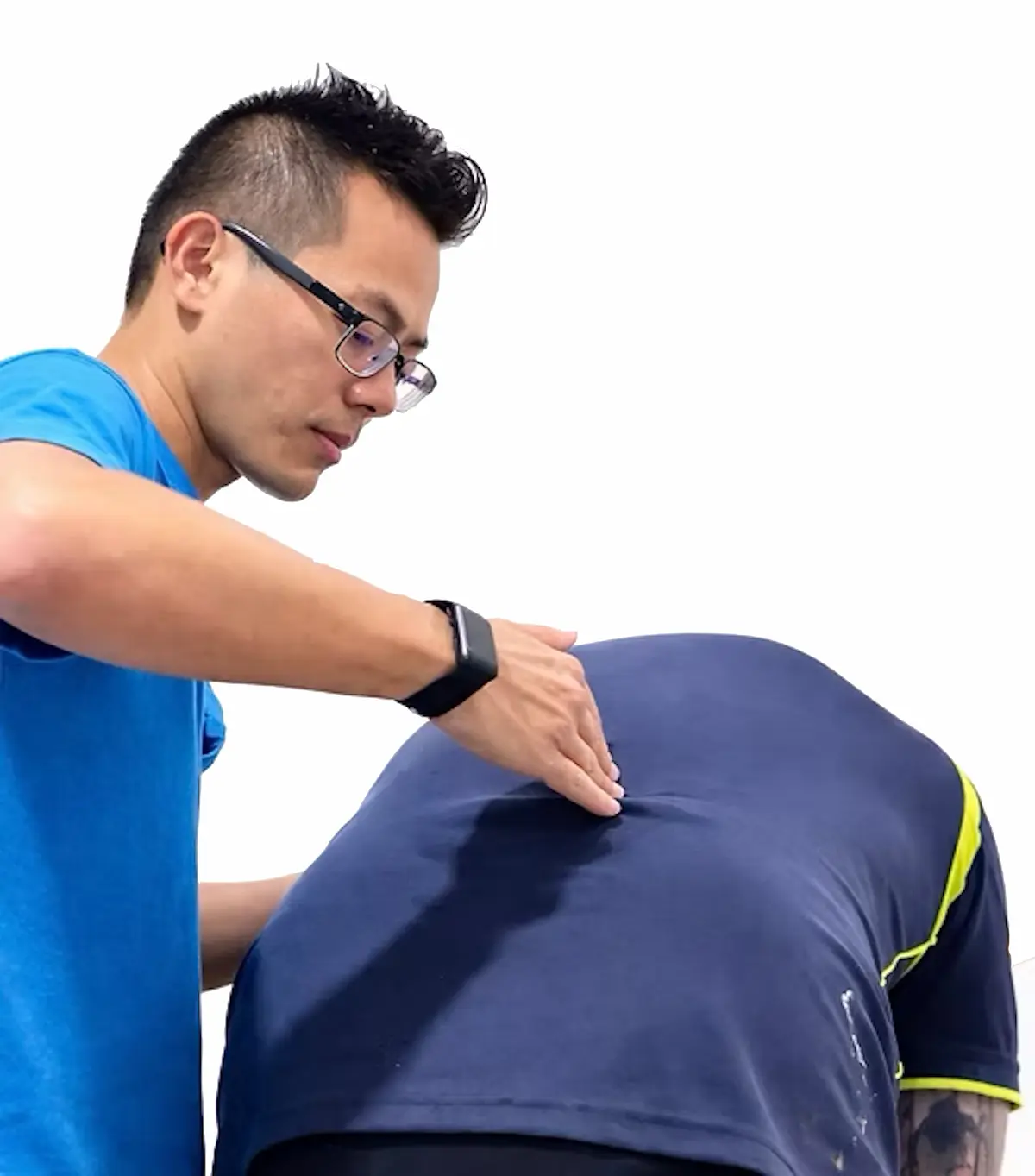
“I’m not aiming for a young athlete who feels loose on the table. I’m aiming for a kid who understands their own body, and a family who knows when to push on and when to get something checked.” — Hill Yang · Remedial Massage Therapist · Exercise Scientist
Growth-related pain
Knee and heel pain in growing kids
Growth-related pain in active children is common and usually settles. It happens because the growth plates and the points where tendon attaches to growing bone are the relatively weak link — which is why youth overuse pain clusters there rather than in the muscle itself. The medical management of these conditions is usually conservative: load modification, ice, sometimes a heel cup or orthotics, and a graded return to sport. That part belongs to your GP or physiotherapist.
Knee pain below the kneecap
Commonly called Osgood-Schlatter disease — pain where the patellar tendon attaches to the tibial tubercle, typically in active 10 to 15 year olds, worse with running, jumping and kicking.
Pain at the bottom of the kneecap
Sinding-Larsen-Johansson — the same mechanism at a different attachment point, managed the same way.
Heel pain
Sever’s disease (calcaneal apophysitis) — one of the most common causes of heel pain in active 8 to 15 year olds, usually diagnosed clinically.
“Growing pains”
The generalised, often evening leg aches many children describe. Common, usually not related to injury, and usually a different pattern to the three above.
Where junior athlete massage fits in: around what a growing body can tolerate — reducing the sense of tightness in the muscles working near a sensitive area, keeping movement comfortable, and giving the athlete something they can actually do themselves.
Where it doesn’t: as a substitute for load management. If training volume doesn’t change, no amount of hands-on work changes that equation, and massage does not change how a growth plate matures.
For parent-friendly medical information on growth-related conditions, The Royal Children’s Hospital Melbourne publishes free Kids Health Info fact sheets, including guidance on Osgood-Schlatter disease.
One pattern I always ask about: back pain in a young athlete. In young athletes, a common cause of low back pain is a stress injury at the pars interarticularis (spondylolysis) — a fatigue injury of the spine that is more likely when pain is worse bending backwards or with loading, and which can progress if it’s trained through. A young athlete with back pain that worsens with extension, or that persists, should be assessed by a GP or physiotherapist first. Early diagnosis is where the good outcomes come from.
I won’t work hands-on with an adolescent’s back pain until that has happened — my back pain page explains how I approach the assessment side.
Junior athlete massage — scope
What I do, and what I don’t do
- I don’t diagnose growth conditions, injuries or developmental conditions — that’s your GP, paediatrician or physiotherapist.
- I’m not a replacement for physiotherapy, sports medicine, or a paediatric review.
- I don’t work on the principle of “no pain, no gain”. If a young athlete’s pain is increasing, the honest answer is usually less load, not more pressure.
- I do screen movement and load tolerance, work hands-on within what a child agrees to, and tell you plainly when something needs to be checked by someone else first.
- Children with disability or developmental differences are welcome — see movement support for neurodivergent children. You don’t need a referral for either.
Safety first
When to see a doctor first
- Back pain in a child under 10 years old
- Pain that wakes them at night, or pain that keeps getting worse over weeks
- Fever, feeling unwell, unexplained weight loss, or night sweats
- Numbness, weakness or tingling, or changes in bladder or bowel control
- Pain that started with a fall or impact, or a leg they can’t put weight on
- Swelling, a lump, or a joint that locks, catches or gives way
- A visible curve in the spine, a step in the spine, or noticeably uneven shoulders or hips
- Back pain that worsens when bending backwards (arching) in a young athlete
- A limp that persists, or pain that changes how they walk
- Anything that concerns you about your child’s safety or care — please raise that with your GP or the relevant service directly
If anything on this list applies, I’ll ask you to have your child medically assessed before we start junior athlete massage together. It’s not a barrier. It’s the safest order of steps.
What to expect
Questions parents ask most
Ready to book
Want your young athlete to train without guessing?
Book a 30-minute junior athlete massage and screening session in Varsity Lakes, or start with an online movement assessment if you’re not local. A parent or carer stays in the room, always.
Educational content only. Not medical advice. Individual results vary. Hill Yang is an ESSA Accredited Exercise Scientist (AES #17005) and Remedial Massage Therapist (MMA #031045). He does not assess, diagnose or treat autism, ADHD or developmental conditions, and does not replace your GP, paediatrician, physiotherapist or occupational therapist. Hill holds a current Queensland Blue Card. For every client aged 3 to 18, a parent or carer remains in the room for the whole session. Always consult a qualified health professional for personal health concerns.