What Force Plate Data Reveals That Visual Assessment Cannot: A Squat Case Study
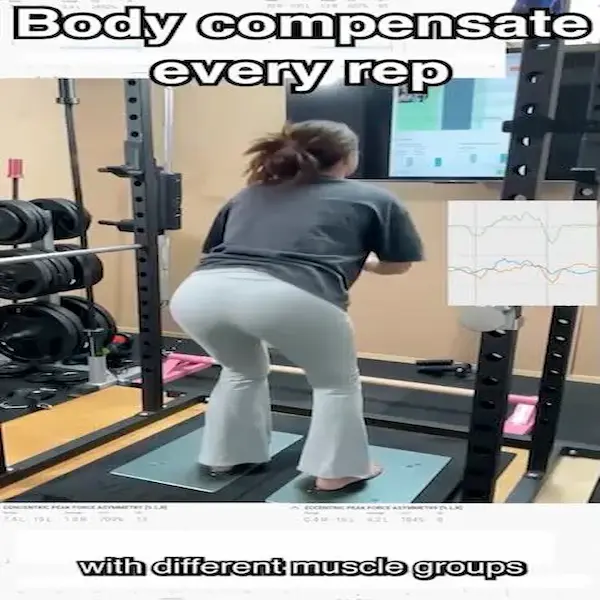
A recent squat assessment at Heal Young Massage. Visual observation found a left hip restriction. Force plate data found something the eye cannot see: an eccentric deceleration coefficient of variation of 667% — meaning no two reps loaded the body the same way.
Clinical Case Study · Gold Coast
Something Worth Documenting from a Recent Assessment
From visual observation alone, the restriction was already identifiable — left hip limitation at approximately 40% squat depth, with tension transferring up through the trunk to the right shoulder.
That finding alone would have been enough to direct treatment. But the force plate data added a second layer that observation could not reach — one that changes the clinical picture significantly.
Two Layers of Assessment
What Each Method Reveals
Visual assessment and objective force plate measurement answer different questions. Both are necessary. One without the other leaves a significant portion of the clinical picture invisible.
What the Body Is Doing
- Left hip restriction onset at approximately 40% squat depth
- Compensatory trunk lateral shift away from the restricted side
- Tension transfer through the thoracolumbar fascia to the right shoulder
- Observable asymmetry in weight distribution and squat path
How the Nervous System Is Managing It
- Braking load shifting from 100% left to 100% right across five repetitions
- Eccentric deceleration coefficient of variation: 667%
- No stable, repeatable movement strategy present
- Different muscle groups recruited on every rep — still searching for a solution
VALD ForceDecks · Assessment Data
The Numbers Behind This Case
Coefficient of Variation
Left → Right
Left Hip Restriction Onset
A CoV of 667% means the eccentric loading strategy was completely different on every repetition. The body had not found a stable, consistent approach to managing the movement under load.
Braking Load Across Five Reps
What 100% → 100% Load Shift Looks Like
In a well-loaded bilateral squat, braking force should be distributed relatively evenly between left and right — and, critically, it should be consistent across repetitions. What the force plate captured here was neither.
Left vs Right Braking Load Per Repetition
Braking load moved from fully left-dominant on rep 1 to fully right-dominant on rep 5 — illustrating that the nervous system was still searching for a strategy to manage the movement, not executing a stable one.
Understanding the Data
What Coefficient of Variation Tells Us About Movement Strategy
Coefficient of variation (CoV) in eccentric deceleration measures how consistent the body’s braking strategy is across repetitions. A low CoV means the nervous system has found a repeatable solution. A high CoV means it hasn’t.
Low CoV — Consistent Loading
The nervous system executes a similar braking strategy on each repetition. Force production and distribution are predictable. The movement is reliable under load — a sign of neuromuscular stability in this pattern.
High CoV — Searching for a Strategy
This case. The nervous system has not found a stable approach. Different muscle groups are recruited on every rep, braking load shifts dramatically side to side, and no two repetitions load the body the same way. The body is compensating — not performing.
The practical implication: if an athlete or client performs this movement in training at volume, they are not just loading one pattern repeatedly — they are reinforcing an unstable one. The accumulation of that variability under progressive load is a meaningful injury risk factor that visual assessment alone would not identify.
“Visual assessment identifies what the body is doing. Objective measurement reveals how the nervous system is managing it — and whether it has found a stable strategy or is still searching for one. Both are necessary. One without the other leaves a significant portion of the clinical picture invisible.”
— Hill Yang · Remedial Massage Therapist & Exercise Scientist · ESSA #17005 | MMA #031045
The Next Step
A Measurable, Objective Outcome Marker
If the left hip restriction improves with treatment, the eccentric deceleration asymmetry is expected to become more evenly distributed and more consistent on retesting. That gives a measurable, objective outcome marker to track — something beyond the subjective experience of “it feels better.”
This is what assessment-led treatment looks like in practice. The force plate doesn’t just identify a problem. It creates a reference point that allows the next assessment to confirm whether the intervention actually changed the underlying movement problem — or only addressed the symptom.
For the broader context on how left hip restrictions relate to lower back pain presentations, see the Chronic Back Pain Gold Coast page — which includes objective force plate data from a complex lumbar rehabilitation case documented over 39 months.
The progression from an unstable eccentric strategy like this one is tracked in full across six assessments in the S1–S4 force plate case study — documenting the point at which a consistent bilateral braking strategy first emerges. The raw S1 and S2 data, including per-rep asymmetry breakdowns from the initial assessments, are presented on the force plate assessment page.
Who Benefits from Force Plate Assessment
When Objective Measurement Changes the Clinical Picture
Athletes with Recurring Niggles
If the same area keeps loading irregularly, it keeps getting irritated. Identifying the variability in loading strategy points toward the actual driver — not the symptom location.
Strength Training Plateau
An inconsistent movement strategy limits strength expression. Identifying and addressing the restriction that’s causing the variability may produce more progress than adding training volume.
Post-Injury Return to Load
Returning to bilateral loading after injury is higher risk without knowing whether the nervous system has re-established a stable, symmetrical strategy. Force plate data makes that visible.
Persistent Movement Discomfort
If a particular movement consistently produces discomfort despite appropriate training and recovery, an unstable loading strategy — not tissue damage — may be the explanation.
Asymmetry That “Feels Fine”
Many clinically significant asymmetries sit below the perceptual threshold — the body has adapted to them and they feel normal. Objective data identifies the gap that subjective experience cannot.
Tracking Treatment Outcomes
Pre- and post-treatment force plate data provides an objective measure of whether an intervention changed the movement pattern — not just whether symptoms improved temporarily.
Book a Force Plate Assessment
VALD ForceDecks at
Heal Young Massage
Hill Yang · ESSA #17005 · MMA #031045

About the Author
Hill Yang
Hill has more than 20 years of clinical experience and over 25,000 hands-on sessions. He combines remedial massage with movement assessment, including force plate and motion-capture tools, to understand how load moves through the body. Hill was part of the medical team at the 2018 Commonwealth Games and is a finalist in the 2026 Australian Small Business Champion Awards (Health Improvement Services). He practises at Heal Young Massage in Varsity Lakes, Gold Coast, and offers sessions in English and Mandarin.