Case Study · Clinical Insights
Charcot-Marie-Tooth Disease and Movement Support:
A Four-Month Movement Observation
This case study documents observed changes in a young client with Charcot-Marie-Tooth disease type 1 (CMT1) — a hereditary peripheral neuropathy — over approximately four months of assessment-led work. It is shared here as a clinical observation, not as a claim about outcomes for CMT1 generally. Individual presentations vary significantly, and this reflects one person’s experience.
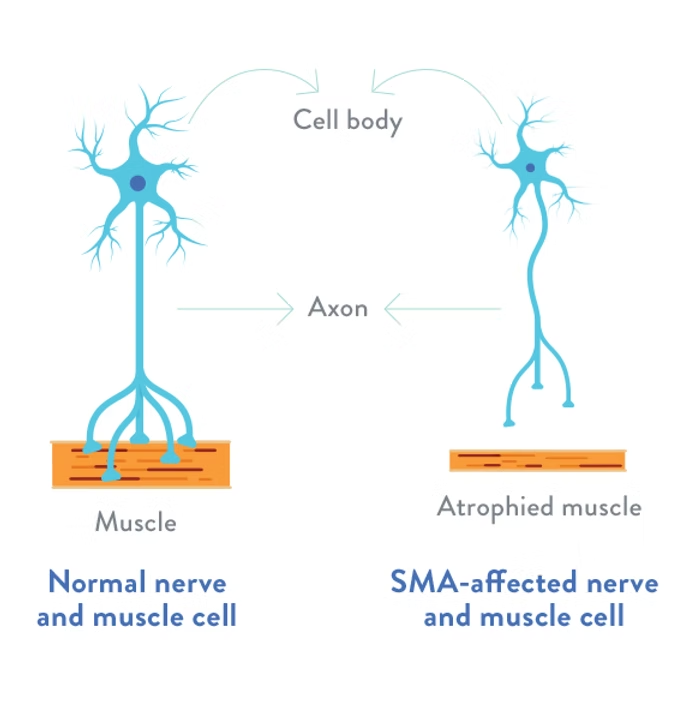
CMT1 is a progressive hereditary neuropathy affecting the peripheral nervous system. It causes gradual muscle weakness, reduced sensation, and structural changes — particularly in the lower limbs — that tend to worsen over time. It is a distinct condition from spinal muscular atrophy (SMA), though both are classified as neuromuscular disorders.
Where the client started
This young client had been living with CMT1 for over three years at the time we began working together. In the two-and-a-half years prior, they had received active intervention from other practitioners with no significant functional improvement. When we first met, their presentation included:
Presenting picture at initial assessment
- Unable to stand without assistive aids
- No sensation in the toes
- Severe foot drop (difficulty lifting the front of the foot)
- Significant ankle deformity
- Condition actively progressing — each month worse than the last
- Marked weakness throughout the posterior chain: back, glutes, and legs
The combination of progressive worsening, prior treatment without improvement, and functional limitations that affected independence made this a genuinely challenging starting point. The goal was not reversal of the underlying condition — that is not what this kind of work does — but to explore what functional capacity could be developed alongside it.
“The question was never whether we could change the diagnosis. It was what this person could build, given where they were starting from.”
The approach
Sessions combined hands-on soft tissue work with a progressive functional loading programme — moving the client through increasingly demanding tasks as capacity developed. The emphasis was on loaded functional movement: walking under resistance, pulling, pushing, and climbing progressions. Each session was preceded by assessment to determine what the client could tolerate that day, and the programme was adjusted accordingly.
This reflects the same principle behind assessment-led treatment more broadly: start with an honest picture of current capacity, then build from there in a structured and observable way.
Movement observations documented over four months
The following are the functional loading markers recorded across the programme. All figures reflect the client’s documented performance at the initial session and at the four-month observation point.
Functional loading observations at two time points (approx. 4 months apart)
| Task | Before | After | |
|---|---|---|---|
| Loaded walking | 2 kg | → | 10 kg |
| Pull walking | 2 kg | → | 11 kg |
| Weighted trolley push | 40 kg | → | 90 kg |
| Climbing wall — angle | 45° | → | 80° |
| Climbing wall — height | 210 cm | → | 270 cm |
| Climbing without aids | Not possible | → | 160 cm |
Client-reported and session-observed changes
Alongside the loading records, the following functional and physical changes were noted by the client and documented across sessions:
- Returning sensation in the toes — gradual and incremental
- Reduced severity of foot drop
- Reduced ankle deformity — improved alignment during standing and movement
- Standing noticeably taller and more upright
- Visible muscle development in the back, glutes, and legs
- Able to stand briefly without assistive aids — not possible at the start
The recorded observations varied between sessions, and the programme was adjusted accordingly. These are documented observations at two time points, not a continuous upward progression.
A reflection
CMT1 is a condition that most practitioners would approach conservatively — and understandably so. The progressive nature of the neuropathy means that expectations are often managed downward from the start. What this case suggested to me is that the body’s adaptive capacity, even in the context of a progressive condition, is often underestimated.
This is not a claim that loading programmes reverse CMT1 or that these results would be replicated in another client. Neuromuscular conditions are complex, presentations vary widely, and one case does not establish a pattern. What it does illustrate is the value of an assessment-led approach that starts with genuine capacity measurement and builds progressively — rather than defaulting to minimal intervention because the diagnosis sounds severe.
Watching this young person stand a little taller at the end of each session, breaking their own records week after week — that stays with you.
If you are supporting someone with a neuromuscular condition and would like to explore what a movement-based, assessment-led approach might look like for their specific situation, the Who I See page gives an overview of the presentations I work with, and the online assessment is available as a starting point regardless of location.
Not sure where to start?
Book a Discovery Assessment at the Varsity Lakes clinic, or start with an online movement assessment from anywhere in Australia.
Disclaimer: This case reflection is provided for general educational purposes only. It is not a claim that remedial massage, myofascial work, exercise science input, or any specific approach can treat, reverse, slow, or improve Charcot-Marie-Tooth disease or any neurological condition. Individual presentations vary significantly. People with neurological conditions should seek personalised advice from their GP, neurologist, physiotherapist, occupational therapist, orthotist, or other appropriately qualified health professional. Hill Yang is an ESSA Accredited Exercise Scientist (AES #17005) and Remedial Massage Therapist (MMA #031045).