Addressing Leg Power Asymmetry
in an Elite Triathlete
A case study from the 2018 Gold Coast ITU Triathlon Elite Race — what leg imbalance looks like in a world-ranked athlete, what was done about it, and what followed.
The Clinical Problem
Leg power asymmetry — and why it matters in triathlon
In a sport that demands sustained, high-output movement across three disciplines, the distribution of effort between the left and right leg has a direct bearing on efficiency, pacing, and injury risk. When one leg is consistently generating more power than the other — whether due to structural restriction, muscular inhibition, or fascial tightness — the athlete is effectively carrying an imbalance through every pedal stroke, every running stride, and every push off the wall in the pool.
At the elite level, this kind of asymmetry rarely presents as obvious pain. It shows up instead as a subtle, persistent drag on output — a feeling that one side isn’t quite keeping up, that certain movement patterns require more conscious effort, or that recovery between sessions is asymmetrical. Most athletes have adapted around it for so long that it can be difficult to perceive from the inside.
The clinical task is identifying where the restriction lives — and whether it can be addressed through soft tissue work.
Impact Across Disciplines
How leg asymmetry affects swim, bike, and run
Swimming
Kick asymmetry & body rotation
Uneven hip flexor and glute loading can produce a lopsided kick pattern, affecting body rotation and increasing drag. Tighter hip structures on one side often create a measurable difference in kick depth and timing.
Cycling
Power output & pedalling efficiency
The bike leg amplifies asymmetry more than any other discipline. With thousands of pedal strokes over a race, a dominant leg will accumulate disproportionate fatigue — and a restricted leg will fail to contribute its share of propulsion.
Running
Stride length & loading pattern
Off the bike, leg asymmetry translates directly into uneven stride length and ground contact time. One leg takes more impact than the other — which compounds over the run leg and increases injury risk in the long term.
“At elite level, asymmetry rarely presents as pain. It presents as a ceiling — a performance limit that the athlete can feel but can’t explain, and that conventional training load adjustments don’t seem to shift.”
The Assessment Approach
What was assessed and addressed
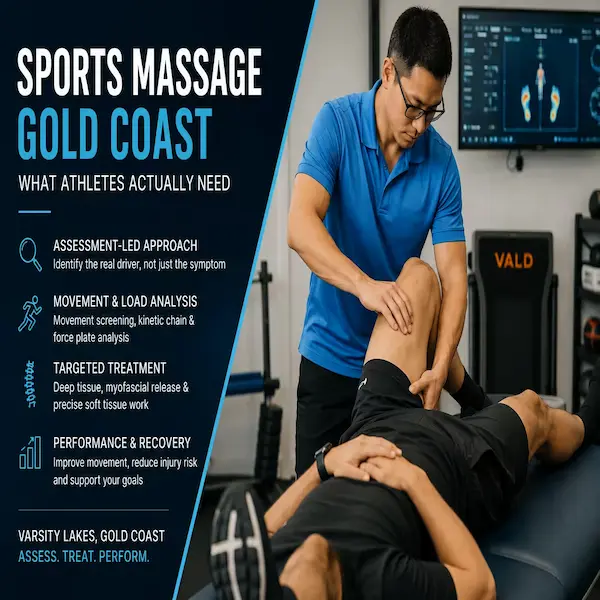
The session with Julia began with a postural and movement assessment to identify where the asymmetry was most pronounced and which structures were likely contributing. In leg power asymmetry presentations, the restriction is rarely in a single muscle — it tends to involve a chain of structures that have adapted around a dominant pattern over time.
Movement and postural assessment
Bilateral comparison of hip flexion and extension range, gluteal activation patterns, and standing alignment. Identifying where the dominant-side compensation was originating and how far it had propagated through the kinetic chain.
Soft tissue assessment of key structures
Palpation and fascial assessment of the hip flexor complex (psoas, iliacus, TFL), gluteal and piriformis group, and posterior chain — comparing left and right for tone, texture, and restriction. The fascial system was a primary focus, given how significantly global fascial patterns can inhibit force transmission in one limb relative to the other.
Dynamic myofascial release — targeting the restricted side
Treatment was directed at the fascial and muscular restrictions on the underperforming side — working to restore length and reduce tone in the structures limiting effective force generation. This was not a bilateral routine; it was targeted work aimed at equalising the load-sharing capacity between legs.
Reassessment and movement check
Following treatment, bilateral comparison was repeated to confirm that range and activation patterns had shifted toward greater symmetry. Movement quality and the athlete’s subjective sense of even loading were both assessed before the session concluded.
Before race
ITU World Triathlon ranking
Following race
+~6 min PB · Gold Coast ITU Elite 2018
Case Observation
Julia — ITU Elite Triathlete, Austria
Single Case Observation · Gold Coast ITU Triathlon Elite Race · September 2018
Julia came in ahead of the Gold Coast ITU Triathlon Elite Race with a presentation consistent with leg power asymmetry — a pattern that had been present in her training load but hadn’t been formally addressed through soft tissue work. The session focused on identifying and releasing the structures limiting force transmission through the restricted leg, with the goal of restoring more even bilateral contribution ahead of race day.
At the Gold Coast ITU Triathlon Elite Race, Julia recorded a personal best improvement of approximately six minutes. Her ITU world ranking subsequently moved from 40th to 36th.
Competitive triathlon performance is influenced by a wide range of factors — training preparation, race conditions, nutrition, coaching, and individual readiness on the day. This case observation is shared as a reflection on the role soft tissue asymmetry may play in performance, and what addressing it can contribute to an athlete’s preparation. It is a single observation and not representative of typical outcomes.
“The goal wasn’t to make her faster. It was to remove a restriction that was limiting what she was already capable of. The performance was already there — the tissue was in the way.”
— Hill Yang · Remedial Massage Therapist
Broader Application
What this means for triathletes at any level
Leg power asymmetry isn’t exclusive to world-ranked athletes. It’s present in age-groupers, club triathletes, and recreational participants alike — and it tends to become more pronounced with accumulated training load over a season. Most people have adapted to it without knowing it’s there.
If you’ve noticed that one leg feels more loaded than the other on the bike, that your run stride feels uneven off the bike, or that one hip or glute is consistently tighter than the other — these are signals worth investigating with a clinical assessment, not just a general stretch routine.
A targeted soft tissue assessment can identify whether restriction in the fascial or muscular system is contributing to the asymmetry, and whether addressing it through manual therapy is likely to have a meaningful impact on how you move.
Are you a triathlete
working around an asymmetry?
An assessment-led session can identify whether soft tissue restriction is limiting your power output — and what can be done about it.
This post describes a single case observation from clinical practice. The outcome reported — including the personal best improvement and world ranking movement — reflects one individual athlete’s experience following treatment, in the context of a competitive event influenced by multiple factors. This observation is not representative of typical or guaranteed outcomes. Individual results vary. This information is intended for general educational purposes and does not constitute medical or performance advice.

About the Author
Hill Yang
Hill has more than 20 years of clinical experience and over 25,000 hands-on sessions. He combines remedial massage with movement assessment, including force plate and motion-capture tools, to understand how load moves through the body. Hill was part of the medical team at the 2018 Commonwealth Games and is a finalist in the 2026 Australian Small Business Champion Awards (Health Improvement Services). He practises at Heal Young Massage in Varsity Lakes, Gold Coast, and offers sessions in English and Mandarin.