When the Scans Are Clear
and the Pain Is Not
Force plate data across four sessions of assessment-led treatment — a de-identified case study documenting what objective eccentric braking assessment reveals that imaging, manual testing, and clinical observation cannot access alone.
About this article: This is a force plate case study based on de-identified VALD ForceDecks data collected at Heal Young Massage, Varsity Lakes, Gold Coast. No personal identifying information is included. All findings are for educational purposes only and do not constitute medical advice or imply guaranteed outcomes for any person. Individual results vary. This post extends the earlier S1–S2 assessment overview published on this site.
This force plate case study begins where most clinical stories do — with a client who had done everything right.
She had seen the sports doctors. She had the MRI, the CT, and the nerve blocks. She tried three different physiotherapists and followed every prescribed exercise programme. And yet, consistently, each time she trained — even gently — she was flat in bed within 24 hours, waiting for the flare to pass. Sometimes for a week.
The scans were clear. Multiple practitioners agreed: structurally, there was no explanation for symptoms at this level. And yet the right leg dragged when she walked. Standing was uncomfortable. Stairs required careful management. She had never been able to run — not once in her adult life — and 18 months after the original injury, she still could not squat.
What follows is the full four-session force plate case study — from the first session in which barely any bilateral braking capacity was present, through to Session 4, where loaded bilateral braking symmetry was achieved for the first time.
“When all the imaging is clear and all the standard treatments have been attempted without lasting effect, the question is not ‘what are we missing structurally?’ — it is ‘what does the neuromuscular system show us that imaging cannot?'”
The Clinical Picture
18 Months. Multiple Practitioners. Scans That Showed Nothing.
Client A presented with right knee pain following a bone bruise in February 2025. A secondary hip flexor complaint had developed by late 2025. By the time of initial assessment at Heal Young Massage in June 2026, she had been managing the combined presentation for approximately 18 months.
The pattern of symptom behaviour was particularly informative. Exercises did not produce pain during the session — they produced it afterwards, reliably, in the 12–24 hour window following activity, and the soreness could persist for up to a week. This delayed inflammatory response is not unusual in the context of a partially inhibited neuromuscular system: the load is not being distributed across the muscles that should absorb it, so the joint receives compressive forces it would otherwise be protected from.
Three physiotherapists had assessed and treated the presentation. Each prescribed progressive exercise. Each, in retrospect, may have been prescribing exercises calibrated for a system that was not yet ready to receive them. The client’s training history before the injury is relevant context: she had squatted 60 kg, deadlifted 60 kg, and hip-thrusted 180 kg. These numbers do not belong to someone with fundamentally weak glutes. The capacity existed. The neuromotor access to that capacity did not.
Understanding the Assessment
Three Metrics That Imaging Cannot Capture
The VALD ForceDecks Squat Test (SQT) protocol measures bilateral force output, movement symmetry, squat depth, and neuromuscular control metrics across every millisecond of every repetition. Three metrics drove the clinical decision-making throughout this force plate case study.
① Eccentric Deceleration Rate of Force Development (RFD)
How quickly the neuromuscular system generates braking force during the lowering phase. When this is impaired or highly variable, the joint absorbs compressive load without muscular protection — producing the delayed soreness pattern Client A described. A high average RFD is not clinically sufficient: the coefficient of variation (CoV) tells you whether that output is organised and reliable rep-to-rep.
② Bilateral Peak Force Asymmetry
The relative contribution of each limb, measured continuously. Consistent asymmetry — even on reps that appear technically acceptable — indicates the nervous system is offloading one side. This is the hallmark of arthrogenic muscle inhibition (AMI): a neurological reflex that persists long after tissue healing. In Client A’s case, the injured right side was under-contributing at baseline and the left was compensating throughout.
③ Coefficient of Variation (CoV)
How consistently force is produced across repetitions. High CoV — even when average values appear acceptable — indicates unpredictable neuromuscular output. In AMI presentations, CoV can be a more sensitive early indicator than averages, because it captures the variability that averages conceal. A CoV of 877% at baseline means the braking system was firing five times harder on one rep than another with no organised pattern between them.
Session 1 — 1 June 2026
What the Baseline Actually Showed
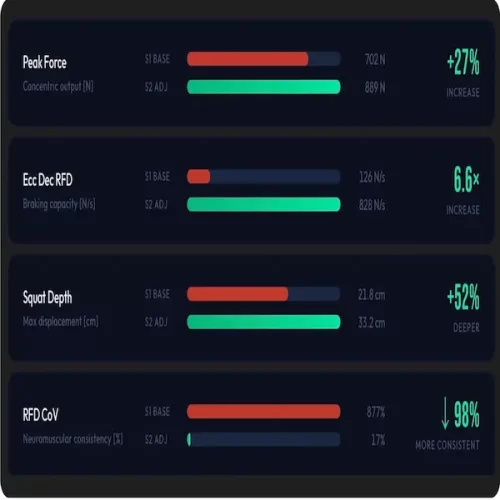
The first force plate assessment used a bodyweight squat protocol across six repetitions. The headline metrics before any treatment was applied were clinically striking, particularly in the eccentric braking domain.
The CoV of 877% is not a rounding artefact. It means two of six repetitions produced near-zero braking (one below 20 N/s, one below 15 N/s), while a later rep reached 232 N/s. The nervous system was not performing poorly in a consistent way — it was producing incoherent output with no organised braking strategy from rep to rep.
The 21.8 cm average depth, with a CoV of 23%, showed similarly disorganised range of motion: the first rep reached only 15.9 cm, the second 29.1 cm. The 8.7% left-dominant peak force asymmetry confirmed the right side — the injured side — was not contributing equally. The left leg was compensating. This is the force plate confirmation of what gait observation had already identified.
Sessions 1 through 4 — 1–13 June 2026
The Full Four-Session Bodyweight Progression
Six bodyweight squat assessments were conducted across four sessions: before and after Session 1, Session 2 adjusted (first two warm-up reps excluded as artefact), before and after Session 3, and a pre-session test at Session 4. The following three charts track the key metrics across these six time points — the core of what makes this force plate case study clinically informative.
Peak Force — Consolidating at a New Level
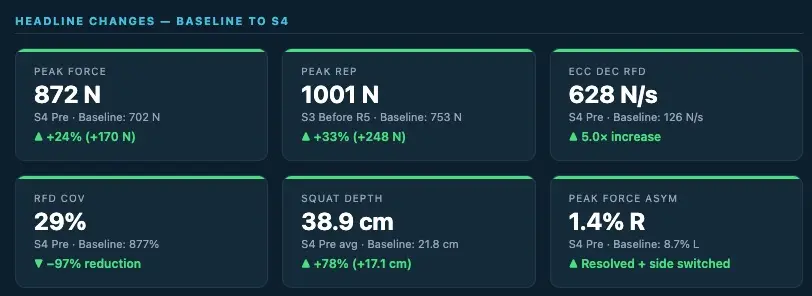
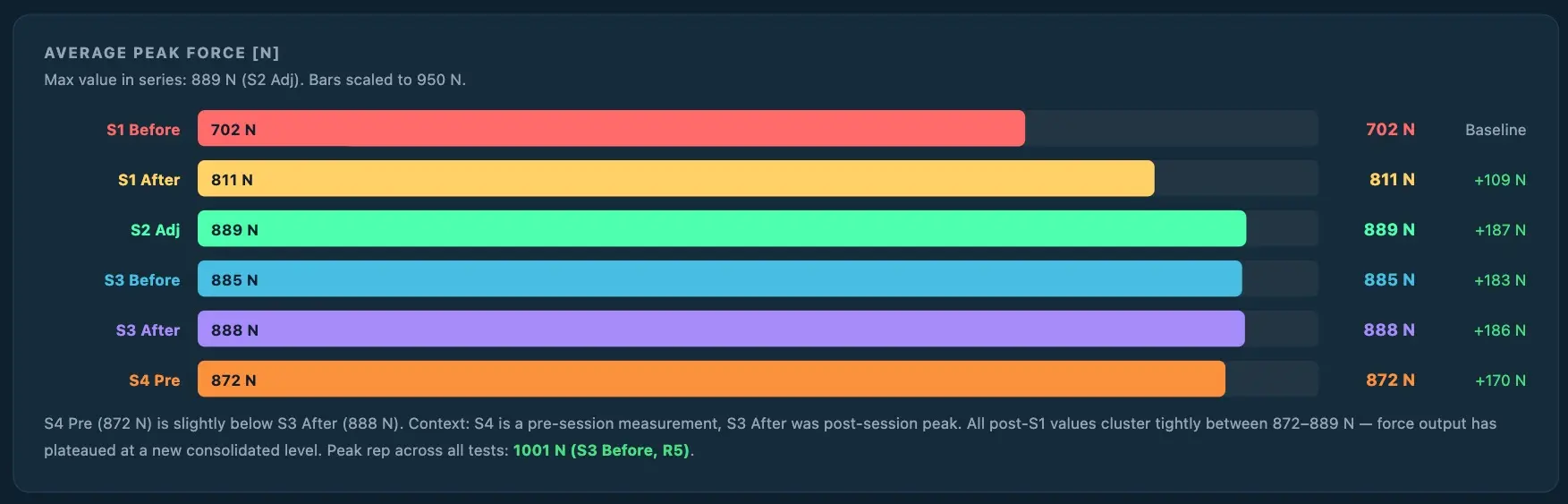
Average peak force rose from 702 N at baseline to a consolidated range of 872–889 N from Session 2 onwards. The single highest rep recorded across all bodyweight tests was 1,001 N (Session 3 Before, Rep 5) — demonstrating that force capacity was not the limiting factor. The system contained that capacity; the problem was whether it could organise and express it reliably.
RFD Coefficient of Variation — From Chaos to Organisation
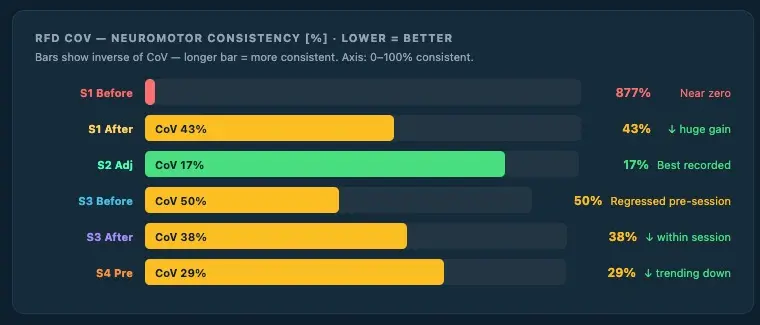
The CoV trend tells a more clinically meaningful story than the average RFD values alone. A drop from 877% (Session 1 Before) to 17% (Session 2 Adjusted) represents a fundamental shift in how the nervous system was organising braking output — from statistically incoherent to exceptionally consistent. The Session 4 pre-session CoV of 29% is the best pre-session value recorded, confirming this organisation is carrying over between sessions.
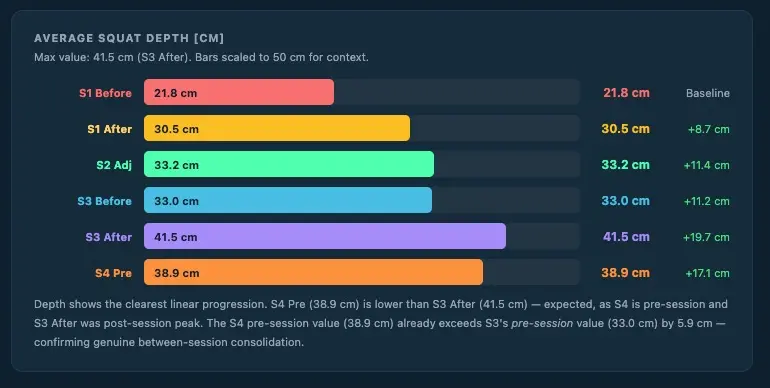
Squat Depth — A Directly Observable Change
Average squat depth increased 78% from baseline (21.8 cm) to Session 4 pre-session (38.9 cm). Depth CoV reduced from 23% to 5.9%. The Session 4 pre-session average (38.9 cm) already exceeds the Session 3 pre-session average (33.0 cm) — confirming genuine between-session consolidation of range, not just within-session peak effects. Deepest single rep: 44.4 cm (Session 3 After, Rep 9).
Complete Bodyweight Dataset
Full Metric Summary — Bodyweight Squat
The table below summarises all key metrics across the six bodyweight squat assessments.
| Metric | S1 Before | S1 After | S2 Adj | S3 Before | S3 After | S4 Pre | Change |
|---|---|---|---|---|---|---|---|
| Force Output | |||||||
| Avg Peak Force [N] | 702 | 811 | 889 | 885 | 888 | 872 | +24% |
| RFD avg [N/s] | 126 | 571 | 828 | 739 | 631 | 628 | 5× increase |
| RFD CoV | 877% | 43% | 17% | 50% | 38% | 29% | ↓97% |
| Squat Depth | |||||||
| Depth avg [cm] | 21.8 | 30.5 | 33.2 | 33.0 | 41.5 | 38.9 | +78% |
| Depth CoV | 23% | 8.4% | 6.5% | 13% | 7.2% | 5.9% | ↓74% |
| Bilateral Symmetry | |||||||
| Peak Force Asym avg | 8.7% L | 3.2% L | 5.0% L | 3.3% L | 3.2% L | 1.4% R | Resolved |
| Ecc Dec Impulse Asym | 13% L | 4.4% L | 7.8% L | 6.5% L | 6.0% L | 1.6% L | Resolved |

Interactive Data Explorer
Explore the Full Bodyweight Squat Dataset
The five tabs below contain the complete bodyweight squat data across six assessments — visual bar charts, full metric table, per-rep breakdowns, bilateral asymmetry visualisations, and a clinical read. Use this to explore the data that underpins the charts above.
Client A — Bodyweight Squat Progression
S1 Before → S1 After → S2 Adjusted → S3 Before → S3 After → S4 Pre-session
All bodyweight tests only · 01/06/2026 – 13/06/2026 · Not for publication without written consent
Average Peak Force [N]
Eccentric Deceleration RFD — Average [N/s]
RFD CoV — Neuromotor Consistency [%] · Lower = Better
Average Squat Depth [cm]
| Metric | S1 Before | S1 After | S2 Adj | S3 Before | S3 After | S4 Pre | Baseline → S4 |
|---|---|---|---|---|---|---|---|
| Date: 01/06 · 01/06 · 06/06 · 10/06 · 10/06 · 13/06 | |||||||
| Reps: 6 · 15 · 10 (adj) · 7 · 9 · 11 | BW: 60.6 · 60.6 · 60.6 · 61.6 · 61.0 · 61.7 kg | |||||||
| Force Output | |||||||
| Peak Force avg [N] | 702 | 811 | 889 | 885 | 888 | 872 | +24% (+170 N) |
| Peak Force CoV | 3.8% | 7.3% | 3.5% | 9.6% | 4.4% | 5.9% | Consistent |
| Peak Force range [N] | 671–753 | 657–903 | 834–925 | 714–1001 | 737–948 | 766–952 | — |
| Peak Force Rep 1 [N] | 698 | 657 | 834 (R3) | 714 | 737 | 766 | +68 N (+10%) |
| Peak Force peak rep [N] | 753 (R4) | 903 (R8) | 925 (R7) | 1001 (R5) | 948 (R9) | 952 (R9) | 1001 — all-time high |
| Conc Peak Force avg [N] | 702 | 811 | 858 | 885 | 865 | 871 | +24% |
| Conc Mean Force avg [N] | 611 | 640 | 637 | 664 | 652 | 653 | +7% (+42 N) |
| Conc Mean Force CoV | 2.7% | 3.4% | 3.0% | 4.4% | 2.8% | 2.0% | Stable, tightening |
| Ecc Peak Force avg [N] | 684 | 806 | 854 | 882 | 862 | 870 | +27% |
| Ecc Mean Force avg [N] | 597 | 596 | 601 | 614 | 603 | 610 | +2% (stable) |
| Ecc Mean Force CoV | 0.4% | 0.2% | 0.4% | 1.3% | 0.6% | 0.2% | Exceptional throughout |
| Eff. Mass (BW) [kg] | 60.6 | 60.6 | 60.6 | 61.6 | 61.0 | 62.2 | +1.6 kg (+2.6%) |
| Eccentric Braking (RFD) | |||||||
| Ecc Dec RFD avg [N/s] | 126 | 571 | 828 | 739 | 631 | 628 | 5.0× (+502 N/s) |
| Ecc Dec RFD CoV | 877% | 43% | 17% | 50% | 38% | 29% | ↓97% (877→29) |
| Ecc Dec RFD Rep 1 [N/s] | 169 | 67 | 625 | 99 | 219 | 248 | +79 N/s from baseline |
| Ecc Dec RFD peak [N/s] | 232 | 1013 | 1013 | 1342 | 933 | 956 | 1342 — all-time high (S3B) |
| Ecc Dec RFD range [N/s] | 12–232 | 67–1013 | 625–1013 | 99–1342 | 219–933 | 248–956 | — |
| Squat Depth | |||||||
| Depth avg [cm] | 21.8 | 30.5 | 33.2 | 33.0 | 41.5 | 38.9 | +78% (+17.1 cm) |
| Depth CoV | 23% | 8.4% | 6.5% | 13% | 7.2% | 5.9% | ↓74% (23→5.9) |
| Depth range [cm] | 15.4–29.1 | 25.0–35.8 | 27.7–35.8 | 22.9–36.5 | 36.3–44.4 | 35.3–44.1 | — |
| Depth Rep 1 [cm] | 15.9 | 29.4 | 28.8 (all R) | 32.1 | 39.1 | 35.3 | +19.4 cm from baseline |
| Depth deepest rep [cm] | 29.1 | 35.8 | 35.8 | 36.5 | 44.4 | 44.1 | +15.0 cm |
| Bilateral Symmetry — BW Tests | |||||||
| Peak Force Asym avg | 8.7% L | 3.2% L | 5.0% L | 3.3% L | 3.2% L | 1.4% R | Resolved + switched |
| Conc Peak Force Asym avg | 8% L | 1.1% L | 4.5% L | 2.9% L | 3.1% L | 1.5% R | Resolved |
| Ecc Peak Force Asym avg | 10% L | 3.4% L | 4.6% L | 3.4% L | 3.1% L | 1.2% R | Resolved |
| Conc Mean Force Asym avg | 11% L | 0.9% L | 5.5% L | 3.3% L | 0.1% L | 8.0% R | Switched — R now elevated |
| Ecc Mean Force Asym avg | 11% L | 3.7% L | 7.8% L | 4% L | 2.2% L | 0.8% R | Resolved |
| Ecc Dec Impulse Asym avg | 13% L | 4.4% L | 7.8% L | 6.5% L | 6% L | 1.6% L | Resolved |
| Ecc Dec RFD Asym avg | 7% R | 13% R | 28% R | 24% R | 4.8% R | 15% R | Improving — within acceptable |
| Ecc Dec RFD Asym CoV | 877% | 164% | — | 148% | 515% | 105% | ↓ organising |
S1 Before · 6 reps
S1 After · 15 reps
S2 Adj · R3–R12
S3 Before · 7 reps
S3 After · 9 reps
S4 Pre · 11 reps
S1 Before
S1 After
S2 Adj (R3–R12)
S3 Before
S3 After
S4 Pre
S1 Before
S1 After
S2 Adj (R3–R12)
S3 Before
S3 After
S4 Pre
Peak Force Asymmetry [%] · LEFT ← | → RIGHT · Scale ±15%
Ecc Dec RFD Asymmetry [%] · LEFT ← | → RIGHT · Scale ±30%
| Metric | S1 Before | S1 After | S2 Adj | S3 Before | S3 After | S4 Pre | Status |
|---|---|---|---|---|---|---|---|
| Peak Force Asym avg | 8.7% L | 3.2% L | 5.0% L | 3.3% L | 3.2% L | 1.4% R | ✓ Resolved |
| Conc Peak Force Asym avg | 8.0% L | 1.1% L | 4.5% L | 2.9% L | 3.1% L | 1.5% R | ✓ Resolved |
| Ecc Peak Force Asym avg | 10% L | 3.4% L | 4.6% L | 3.4% L | 3.1% L | 1.2% R | ✓ Resolved |
| Conc Mean Force Asym avg | 11% L | 0.9% L | 5.5% L | 3.3% L | 0.1% L | 8.0% R | ⚠ Switched — monitor |
| Ecc Mean Force Asym avg | 11% L | 3.7% L | 7.8% L | 4.0% L | 2.2% L | 0.8% R | ✓ Near zero |
| Ecc Dec Impulse Asym avg | 13% L | 4.4% L | 7.8% L | 6.5% L | 6.0% L | 1.6% L | ✓ Resolved |
| Ecc Dec RFD Asym avg | 7% R | 13% R | 28% R | 24% R | 4.8% R | 15% R | ↓ Improving — acceptable BW |
| Session | Key Observation | Force | RFD | Depth | Asym |
|---|---|---|---|---|---|
| S1 Before | AMI state — system barely engaged. Baseline. | 702 N | 126 N/s CoV 877% | 21.8 cm | 8.7% L |
| S1 After | Immediate unlock within session. Clinical confirmation of AMI. | 811 N | 571 N/s CoV 43% | 30.5 cm | 3.2% L |
| S2 Adj | System reorganised. Best CoV (17%). Force ceiling rising. | 889 N | 828 N/s CoV 17% | 33.2 cm | 5.0% L |
| S3 Before | All-time RFD peak (1342 N/s). R1 still suppressed. | 885 N | 739 N/s CoV 50% | 33.0 cm | 3.3% L |
| S3 After | Depth breakthrough post-session. Best BW depth. | 888 N | 631 N/s CoV 38% | 41.5 cm | 3.2% L |
| S4 Pre | Pre-session depth already exceeds S3 Before. Consolidation confirmed. | 872 N | 628 N/s CoV 29% | 38.9 cm | 1.4% R |
| Comparison | Metric | Value | Significance |
|---|---|---|---|
| S3 Before → S4 Pre | Depth avg | 33.0 → 38.9 cm (+5.9 cm) | Pre-session floor rose by 5.9 cm between sessions — retained gain |
| S3 Before → S4 Pre | Depth floor (R3+) | ~34 cm → ~40 cm | Working-set floor lifted — new consolidated range |
| S3 After best → S4 Pre R4 | Peak depth | 44.4 → 44.1 cm | Pre-session now matching post-session S3 peak |
| S3 Before → S4 Pre | RFD CoV | 50% → 29% | Between-session CoV improvement — system more organised at start |
| S1 Before → S4 Pre | Depth avg | 21.8 → 38.9 cm | +78% over four sessions — the defining movement change in this case |
Clinical Reasoning
Why Previous Exercise Prescription May Have Made Things Worse
This is not a criticism of previous practitioners. It is an attempt to explain, using the force plate data, why a particular pattern of symptom exacerbation may have occurred despite well-intentioned and structurally appropriate exercise prescription.
The baseline data shows a braking system with a CoV of 877% — one that produced near-zero eccentric output on multiple repetitions within a single six-rep set. When exercise is prescribed to a system in this state, the load does not distribute the way it would for an organised neuromuscular system. Instead, it preferentially goes to whichever structures are willing to accept it — in this case, the hip flexor chain and the left limb, which had been compensating for the right for 18 months.
The other relevant factor: a 180 kg hip thrust indicates well-developed posterior chain capacity. But hip thrust capacity does not automatically transfer to knee-loading tasks if the neuromotor pathway for loading the knee is inhibited. Prescribing more hip-focused strengthening may not address the inhibition pattern at the knee. The assessment needed to start with what the system could actually organise under load, not what it had previously been capable of producing.
Sessions 3 & 4 — Loaded Assessment
Adding External Load — The 10 kg Squat Data
Beginning in Session 3, the assessment protocol was extended to include a loaded squat with 10 kg of additional weight. The loaded test is a more demanding probe of bilateral braking organisation: bodyweight squats allow compensation strategies that become harder to sustain when load is added. For this client, the loaded test exposed braking asymmetry patterns that were partially masked in the bodyweight data.
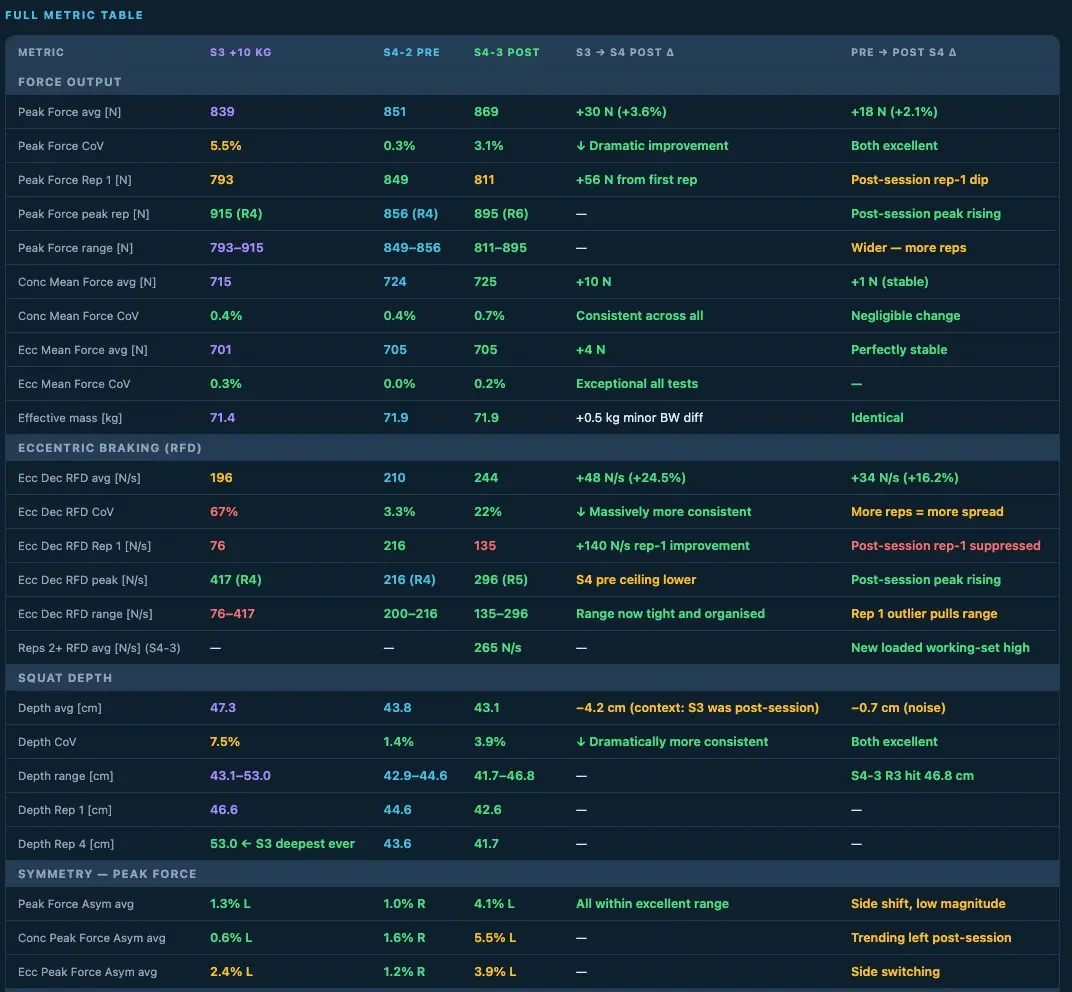
Three loaded assessments were conducted: Session 3 (4 reps), Session 4-2 pre-session (4 reps), and Session 4-3 post-session (6 reps).

The most clinically significant finding under load was the eccentric braking asymmetry. In Session 3, loaded RFD asymmetry averaged 52% right-dominant — and on Rep 1, reached 95% right-dominant. The left leg was contributing almost nothing to eccentric braking while the right was doing nearly all the work. This is the inverse of the bodyweight pattern (where left had been dominant), reflecting the complexity of compensation as the previously inhibited right leg began to over-contribute once some neuromotor activity was restored.
| Metric | S3 (10 Jun) | S4-2 Pre (13 Jun) | S4-3 Post (13 Jun) | S3 → S4-Post |
|---|---|---|---|---|
| Force Output | ||||
| Avg Peak Force [N] | 839 | 851 | 869 | +3.6% |
| RFD avg [N/s] | 196 | 210 | 244 | +24.5% |
| RFD CoV | 67% | 3.3% | 22% | ↓67% |
| Bilateral Symmetry | ||||
| RFD Asym avg | 52% R | 48% R | 31% R | ↓40% |
| RFD Asym Rep 1 | 95% R | 57% R | 70% R | Improving |
| RFD Asym Rep 3 | 47% R | 44% R | 4% L ← symmetry | First bilateral |
| Squat Depth | ||||
| Depth avg [cm] | 47.3 | 43.8 | 43.1 | — |
| Depth CoV | 7.5% | 1.4% | 3.9% | ↓48% |
Interactive Data Explorer
Explore the Loaded Squat Dataset
The five tabs below contain the complete +10 kg loaded squat data across three assessment conditions — per-rep detail, asymmetry visualisations, RFD deep dive with the three-stage reorganisation pattern, and clinical interpretation including S5 targets.
Client A — +10 kg Loaded Squat: S3 vs S4-2 vs S4-3
Full per-rep data from raw PDFs · S3: 10/06/2026 · S4: 13/06/2026 · Not for publication without written consent
| Metric | S3 +10 kg | S4-2 Pre | S4-3 Post | S3 → S4 Post Δ | Pre → Post S4 Δ |
|---|---|---|---|---|---|
| Force Output | |||||
| Peak Force avg [N] | 839 | 851 | 869 | +30 N (+3.6%) | +18 N (+2.1%) |
| Peak Force CoV | 5.5% | 0.3% | 3.1% | ↓ Dramatic improvement | Both excellent |
| Peak Force Rep 1 [N] | 793 | 849 | 811 | +56 N from first rep | Post-session rep-1 dip |
| Peak Force peak rep [N] | 915 (R4) | 856 (R4) | 895 (R6) | — | Post-session peak rising |
| Peak Force range [N] | 793–915 | 849–856 | 811–895 | — | Wider — more reps |
| Conc Mean Force avg [N] | 715 | 724 | 725 | +10 N | +1 N (stable) |
| Conc Mean Force CoV | 0.4% | 0.4% | 0.7% | Consistent across all | Negligible change |
| Ecc Mean Force avg [N] | 701 | 705 | 705 | +4 N | Perfectly stable |
| Ecc Mean Force CoV | 0.3% | 0.0% | 0.2% | Exceptional all tests | — |
| Effective mass [kg] | 71.4 | 71.9 | 71.9 | +0.5 kg minor BW diff | Identical |
| Eccentric Braking (RFD) | |||||
| Ecc Dec RFD avg [N/s] | 196 | 210 | 244 | +48 N/s (+24.5%) | +34 N/s (+16.2%) |
| Ecc Dec RFD CoV | 67% | 3.3% | 22% | ↓ Massively more consistent | More reps = more spread |
| Ecc Dec RFD Rep 1 [N/s] | 76 | 216 | 135 | +140 N/s rep-1 improvement | Post-session rep-1 suppressed |
| Ecc Dec RFD peak [N/s] | 417 (R4) | 216 (R4) | 296 (R5) | S4 pre ceiling lower | Post-session peak rising |
| Ecc Dec RFD range [N/s] | 76–417 | 200–216 | 135–296 | Range now tight and organised | Rep 1 outlier pulls range |
| Reps 2+ RFD avg [N/s] (S4-3) | — | — | 265 N/s | — | New loaded working-set high |
| Squat Depth | |||||
| Depth avg [cm] | 47.3 | 43.8 | 43.1 | −4.2 cm (context: S3 was post-session) | −0.7 cm (noise) |
| Depth CoV | 7.5% | 1.4% | 3.9% | ↓ Dramatically more consistent | Both excellent |
| Depth range [cm] | 43.1–53.0 | 42.9–44.6 | 41.7–46.8 | — | S4-3 R3 hit 46.8 cm |
| Depth Rep 1 [cm] | 46.6 | 44.6 | 42.6 | — | — |
| Depth Rep 4 [cm] | 53.0 ← S3 deepest ever | 43.6 | 41.7 | — | — |
| Symmetry — Peak Force | |||||
| Peak Force Asym avg | 1.3% L | 1.0% R | 4.1% L | All within excellent range | Side shift, low magnitude |
| Conc Peak Force Asym avg | 0.6% L | 1.6% R | 5.5% L | — | Trending left post-session |
| Ecc Peak Force Asym avg | 2.4% L | 1.2% R | 3.9% L | — | Side switching |
| Symmetry — Eccentric Braking | |||||
| Ecc Dec RFD Asym avg | 52% R | 48% R | 31% R | −21pp (S3→S4 post) | −17pp within session |
| Ecc Dec RFD Asym range | 25–95% R | 37–57% R | 4%L–70% R | Range tightening | — |
| Ecc Dec RFD Asym CoV | 53% | 17% | 80% | S4-2 organised | S4-3 variable — wider range |
| Conc Mean Force Asym avg | 5.9% R | 2.0% R | 3.4% L | Improving | Side shift |
| Ecc Mean Force Asym avg | 5.8% L | 5.6% L | 7.8% L | Stable S3→S4 pre | ↑ Post-session worsened |
| Ecc Dec Impulse Asym avg | 4.7% L | 3.3% L | 10% L | Stable S3→S4 pre | ↑ Post-session worsened |
S3 +10 kg
S4-2 Pre-session
S4-3 Post-session
S3 +10 kg
S4-2 Pre-session
S4-3 Post-session
S3 +10 kg
S4-2 Pre-session
S4-3 Post-session
S3 +10 kg
S4-2 Pre-session
S4-3 Post-session
Average RFD Asymmetry — Scale 0–100% Right
Each rep’s RFD asymmetry [% Right] — bar length = magnitude
Eccentric Mean Force Asym [%] · LEFT ← | → RIGHT
Ecc Dec Impulse Asym [%] · LEFT ← | → RIGHT
Conc Mean Force Asym [%] · LEFT ← | → RIGHT
Stage 1: S3 — Chaotic
Stage 2: S4-2 — Organised
Stage 3: S4-3 — Expanding
| Priority | Metric | S4 Best | S5 Target |
|---|---|---|---|
| 1 | Ecc Dec RFD Asym avg | 31% R (post) | <20% sustained, both tests |
| 2 | Ecc Dec Impulse Asym | 10% L (post) | <5% both tests |
| 3 | Ecc Mean Force Asym | 7.8% L (post) | <5% both tests |
| 4 | RFD Rep 1 (post-session) | 135 N/s | >200 N/s from rep 1 |
| 5 | Ecc Dec RFD avg (post) | 244 N/s | >300 N/s working-set avg |
| 6 | RFD symmetrical reps | 1 rep achieved (<10%) | ≥3 consecutive reps <20% |
| 7 | Squat depth avg | 43–44 cm consistent | Maintain + extend peak >47 cm |
Neuromotor Reorganisation Pattern
Three Stages of Eccentric Braking Reorganisation
Across Sessions 3 and 4, the loaded eccentric braking system moved through a recognisable three-stage reorganisation pattern. This progression — from chaotic output, to organised but constrained output, to expanding capacity with emerging symmetry — is consistent with what the research literature describes in the resolution of arthrogenic muscle inhibition.
Stage 1 · Session 3
Chaotic
Braking neurologically inhibited. Rep 4 fired 5.5× harder than Rep 1. No organised strategy present.
Stage 2 · S4 Pre-session
Organised
System reorganised to consistent output. All four reps within 16 N/s. Asymmetry descending within the set.

Depth–RFD connection within Session 4-3: Rep 3 simultaneously produced the deepest loaded squat in that test (46.8 cm), the lowest asymmetry (4% L — symmetry), and an above-average RFD value. Rep 4 — where asymmetry spiked back to 53% R — was the shallowest rep (41.7 cm). When neuromotor inhibition clears, both depth and bilateral loading appear to recover together. When inhibition reasserts, both retreat simultaneously.
Clinical Boundaries
What the Data Does Not Tell Us
Four sessions of force plate data across 13 days provide an informative pattern — but not a conclusion. Several important caveats apply to this force plate case study.
Force plate metrics do not tell us whether someone is out of pain. They do not confirm a diagnosis or explain the origin of a specific inhibition pattern. They are one layer of objective information in a clinical picture that also includes hands-on assessment, movement observation, and the client’s subjective report. If you want to understand what a force plate assessment at Heal Young Massage involves before booking, the online movement assessment ($50) is a good starting point.
In this case, the work is ongoing. The RFD asymmetry under load remains elevated — averaging 31% right-dominant at Session 4 post-session, with individual reps still reaching 70% at the start of the post-session test. The eccentric impulse asymmetry warrants dedicated attention. The abdominal presentation and its relationship to the longstanding running limitation has not yet been formally addressed. These threads carry into Session 5 and beyond.
What the data offers is something that is otherwise very difficult to access clinically: whether the nervous system is organising movement in a coherent way, or suppressing output to protect a structure that — according to imaging — no longer needs protecting. That question can only be answered if you measure it.
Clinical Takeaways
What This Case Illustrates
The following observations are drawn from this case for educational purposes only. They are not generalisable claims about outcomes for any other presentation.
AMI persists after structural healing
Arthrogenic muscle inhibition is a neurological reflex driven by joint afferents. It does not resolve automatically when tissue heals, and it is invisible to standard imaging. Its primary footprint is in RFD variability and bilateral symmetry metrics, not average force values.
CoV is more sensitive than averages
High coefficient of variation in eccentric metrics can be clinically significant even when average force output appears acceptable. CoV captures the disorganisation that averages conceal — and disorganisation is what determines load distribution at the joint level.
Prescription must match neuromotor state
Progressive loading applied to a limb with impaired eccentric deceleration capacity may reinforce compensation patterns and contribute to ongoing symptom cycles — regardless of how well the exercise is designed structurally. Prescription dose must match what the system can actually organise.
Observation and measurement are complementary
The clinical eye identifies the pattern. Force plate technology quantifies it, documents it, and makes it trackable — enabling more precise load management decisions and clearer communication across multidisciplinary care teams.
Reorganisation follows a recognisable arc
Chaos → organised → expanding. This three-stage neuromotor pattern appeared in both the bodyweight and loaded assessments. The transition from Stage 1 to Stage 2 is often the most clinically meaningful change — even when Stage 2 absolute values are lower than unreliable Stage 1 peaks.
Depth and bilateral loading appear linked
In this case, the rep that achieved bilateral braking symmetry also produced the deepest loaded squat. When symmetry regressed on the following rep, depth decreased simultaneously. Range of motion and neuromuscular organisation appear mechanistically connected in this presentation.
What the Assessments Showed
Measurable Changes — Sessions 1 to 4
Across four sessions and 13 days of assessment, the following changes were documented in the force plate data.
About This Approach
Assessment-Led Treatment at Heal Young Massage
The VALD ForceDecks system is used in elite sport and high-performance settings to objectively quantify lower limb neuromuscular function. At Heal Young Massage, we use it as part of a comprehensive clinical assessment framework — not as a standalone tool, but as an additional lens that validates and documents clinical observations. You can read about our force plate assessment approach and the S1–S2 data from this case in the earlier post.
Our approach is grounded in the principle that the practitioner’s clinical eye is the primary instrument. Technology serves to make what is observed measurable, trackable, and communicable — particularly when working as part of a multidisciplinary team supporting a client’s rehabilitation or return to activity.
This force plate case study is particularly relevant for clients who present with persistent symptoms where standard diagnostic pathways have not identified a clear structural explanation, and where the question of neuromotor organisation has not yet been formally explored.
Hill Yang is an ESSA Accredited Exercise Scientist (AES #17005) and Remedial Massage Therapist (MMA #031045) with over 20 years of clinical experience and more than 25,000 sessions.
Heal Young Massage · Varsity Lakes, Gold Coast
Interested in Objective Movement Assessment?
Whether you are managing a persistent lower limb presentation, preparing for a return to sport, or working towards LA28 or Brisbane 2032 — force plate assessment is available at our Varsity Lakes clinic as part of a comprehensive clinical framework.
Educational content only. Not medical advice. Individual results vary. This article presents de-identified force plate assessment data for educational purposes only. Findings reflect one individual’s assessment data at specific time points and do not constitute medical advice or imply guaranteed outcomes for any person. Hill Yang is an ESSA Accredited Exercise Scientist (AES #17005) and Remedial Massage Therapist (MMA #031045) at Heal Young Massage, 21 Meridien Avenue, Varsity Lakes QLD 4227. Always consult a qualified health professional for personal health concerns.