
Movement · Recovery · Body Composition
How Remedial Massage Can Support Fat Loss and Long-Term Health
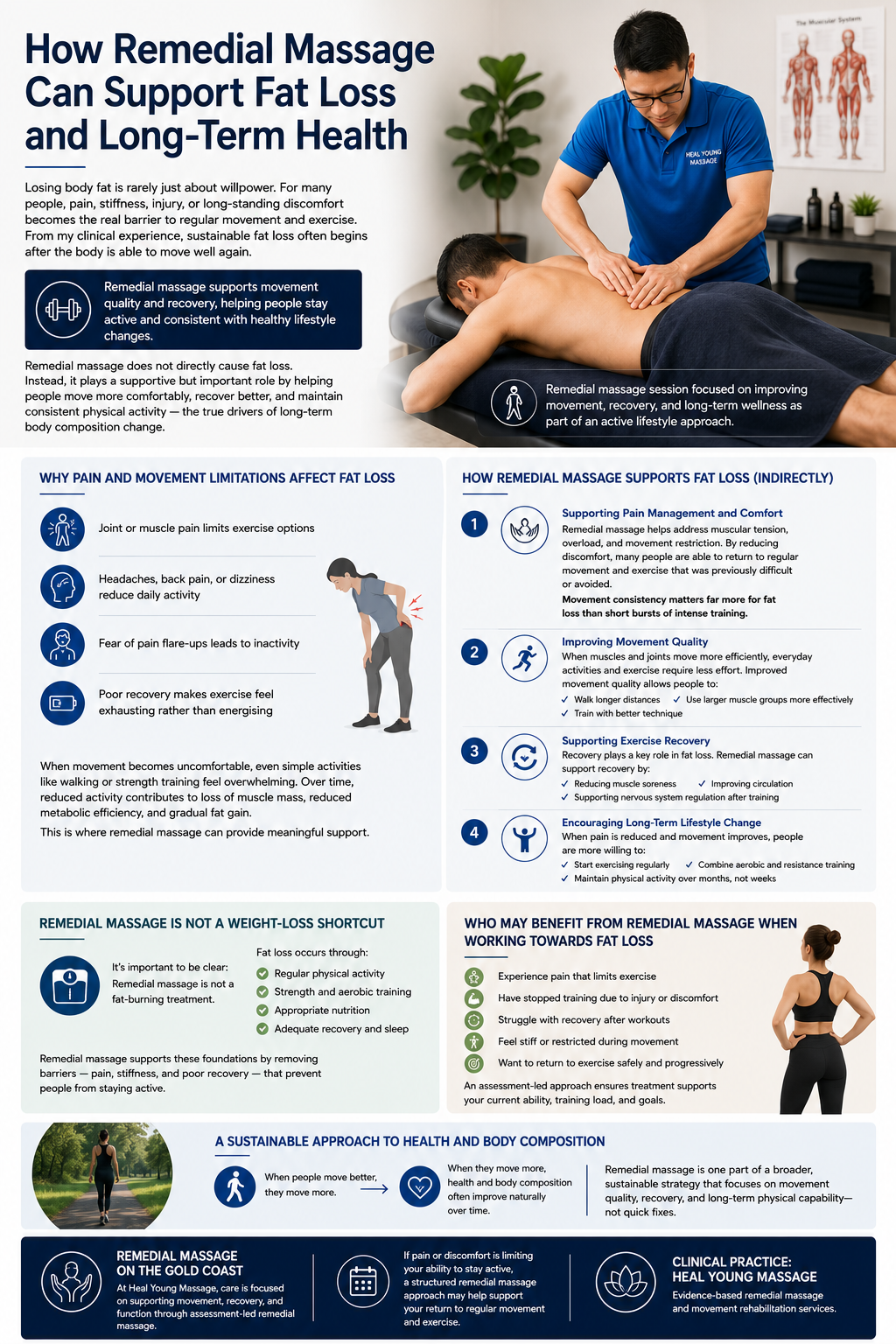
Losing body fat is rarely just about willpower. For many people, pain, stiffness, or injury becomes the real barrier to regular movement. Sustainable change often begins after the body is able to move well again.
Remedial massage does not directly cause fat loss. That is important to say clearly at the outset. What it can do — and what many clients experience — is remove some of the barriers that prevent people from moving consistently. And consistent movement is one of the most significant drivers of long-term body composition change.
This post explores the indirect but meaningful role remedial massage may play in supporting fat loss goals — from reducing pain that limits exercise, to improving recovery, to helping people sustain the movement habits that matter most. Individual results vary, and this is not a replacement for nutrition, training, and broader lifestyle guidance.
The Real Barrier
Why Pain & Movement Limitations Affect Fat Loss
Many people who want to lose body fat are not struggling with knowledge or motivation — they’re struggling with a body that makes regular activity difficult. Common physical barriers seen in clinical practice include:
When movement becomes uncomfortable or unreliable, even simple activities like walking or strength training feel overwhelming. Over time, reduced activity contributes to a pattern that works against long-term health and body composition goals.
The Indirect Role
How Remedial Massage May Support Fat Loss
The four mechanisms below are not about massage directly burning fat. They are about removing the barriers that prevent people from being consistently active — which is the actual driver of long-term body composition change.
Supporting Return to Movement
By working with muscular tension, overload patterns, and soft tissue restriction, remedial massage may reduce the discomfort that keeps people away from regular exercise. Movement consistency matters far more for fat loss than short bursts of intense training.
More Efficient Use of the Body
When muscles and joints move more efficiently, everyday activities and exercise require less compensation. Improved movement quality allows people to walk longer distances, train with better technique, and use larger muscle groups more effectively — increasing overall energy expenditure without necessarily increasing perceived effort.
Training More Consistently
When recovery is poor, people reduce training frequency or intensity — often without realising it. Remedial massage may support recovery by reducing muscle soreness, improving circulation to working tissues, and supporting nervous system regulation after training. Better recovery makes consistent training sustainable over months, not just weeks.
Sustaining Long-Term Habits
One of the more significant clinical observations is confidence. When pain is reduced and movement improves, people become more willing to start exercising regularly, combine aerobic and resistance training, and maintain physical activity over months. This long-term consistency is what drives sustainable change in body composition and overall health.
“From years of clinical practice, one pattern remains consistent: when people move better, they move more. When they move more, health and body composition often improve naturally over time.”Hill Yang · Remedial Massage Therapist & Exercise Scientist · Varsity Lakes, Gold Coast
Being Honest About What Massage Is
Remedial Massage Is Not a Weight-Loss Shortcut
Clarity matters here. Remedial massage is a supportive tool within a broader approach — it does not replace the foundations of fat loss and long-term health.
What actually drives fat loss — and where massage fits
✓ The true drivers of fat loss
- Regular physical activity — especially strength training combined with aerobic work
- Appropriate, sustainable nutrition
- Adequate sleep and recovery
- Consistency over weeks and months, not days
- Managing stress and its effect on appetite and energy
→ Where massage may play a supporting role
- Reducing pain that is limiting access to exercise
- Improving movement quality so training is more effective
- Supporting recovery so training can be more consistent
- Helping people re-engage with physical activity after injury or long inactivity
- Part of a broader, sustainable health strategy — not a standalone solution
A Different Perspective
Remedial Massage Combined with Exercise Science
Most remedial massage therapists work purely in soft tissue — they assess and treat the tissue. At Heal Young Massage, the approach is informed by a dual background in both remedial massage and exercise science.
Exercise Scientist + Remedial Massage Therapist
Hill Yang holds dual credentials as an ESSA Accredited Exercise Scientist (AES #17005) and a Remedial Massage Therapist (MMA #031045). This means that conversations about activity, training load, movement quality, and body composition goals can be informed by both soft tissue assessment and exercise science principles — not just the massage component in isolation.
For clients working towards fat loss goals who are also dealing with pain or movement restriction, this combination allows for a more integrated view of what is limiting progress and what practical steps may help.
Is This Approach Relevant to You?
Who May Benefit from This Approach
Pain limiting your exercise options
Back pain, hip pain, knee pain or shoulder issues that restrict the type or volume of training you can do.
Stopped training due to injury
A previous injury that hasn’t fully resolved and is now limiting your ability to return to regular physical activity.
Poor recovery after workouts
Feeling persistently sore or fatigued after training in a way that reduces your frequency or quality of subsequent sessions.
Stiff or restricted movement
Feeling tight or limited in range — particularly in the hips, thoracic spine, or shoulders — in a way that affects exercise technique and energy expenditure.
Want to return to exercise safely
Looking to re-engage with physical activity after a period of inactivity and wanting an assessment-informed starting point.
Active but plateauing
Already exercising regularly but finding that movement restrictions or recurring discomfort are affecting training quality and progression.
In Practice
What a Supportive Approach Looks Like
Rather than treating massage as a stand-alone fat-loss modality, a more useful framing is as one component within a broader health and activity strategy. Here is how that typically develops over time.
Assessment — understand what is limiting movement
Identify the specific pain patterns, movement restrictions, or recovery issues that are creating barriers to consistent activity. This shapes everything that follows.
Targeted soft tissue work — address the barriers
Remedial massage, myofascial release, and dry needling directed at the patterns identified in assessment — not a generic full-body relaxation session.
Movement guidance — re-engage with physical activity
Practical guidance on returning to or progressing exercise in a way that is appropriate to the current tissue state and movement capacity.
Recovery support — sustain consistent training
Ongoing sessions timed around training load to support recovery and maintain the movement quality needed for consistent, effective exercise.
Broader health strategy — massage as one part
Referral or collaboration with other health professionals (GP, dietitian, exercise physiologist) where appropriate — particularly for clients where nutrition, medical factors, or structured exercise programming are the primary need.
Pain Limiting Your Activity and Progress?
If discomfort, stiffness, or poor recovery is the real barrier to moving consistently, an assessment-led session at the Varsity Lakes clinic can help identify what’s getting in the way. Individual results vary — but moving better is always the starting point.
Educational content only. Not medical advice. Individual results vary. Remedial massage does not directly cause fat loss and is not a weight-loss treatment. Information in this post is intended for general educational purposes. Fat loss and body composition change result from physical activity, nutrition, recovery, and broader lifestyle factors. Always consult a qualified health professional for personal health and body composition guidance.

About the Author
Hill Yang
Hill has more than 20 years of clinical experience and over 25,000 hands-on sessions. He combines remedial massage with movement assessment, including force plate and motion-capture tools, to understand how load moves through the body. Hill was part of the medical team at the 2018 Commonwealth Games and is a finalist in the 2026 Australian Small Business Champion Awards (Health Improvement Services). He practises at Heal Young Massage in Varsity Lakes, Gold Coast, and offers sessions in English and Mandarin.


