Struggling with Exercise?
Check the 72-Year-Old Female Powerlifter.
Oxford University fellow Dr Catherine Walter discovered powerlifting at 65. Seven years later, she’s a world record holder — and her bone density is that of a 20-year-old. If you’re looking for a reason to start, here it is.
The Story
She Started at 65. By 72, She Was a World Record Holder.
If you’ve been putting off starting an exercise programme — because you’re too old, too far behind, or the window has passed — Dr Catherine Walter’s story deserves your attention.
An Oxford University fellow, Dr Walter discovered powerlifting at the age of 65. Not as a casual hobby, but with the seriousness of someone who had found something genuinely important. Within seven years she had become a powerlifting club captain, a world record holder, and a 2018 World Drug-Free Powerlifting Federation (WDFPF) champion in her age and weight category.
But the most remarkable detail isn’t her competition record. It’s what happened to her bones. After committing to powerlifting training, her bone density was assessed as equivalent to that of a 20-year-old. At 72. From a woman who began lifting weights at an age when most people are being advised to take things gently.
This isn’t an anecdote about exceptional genetics or unusual circumstances. It’s a demonstration of what the human body remains capable of — at any age — when given the right stimulus.
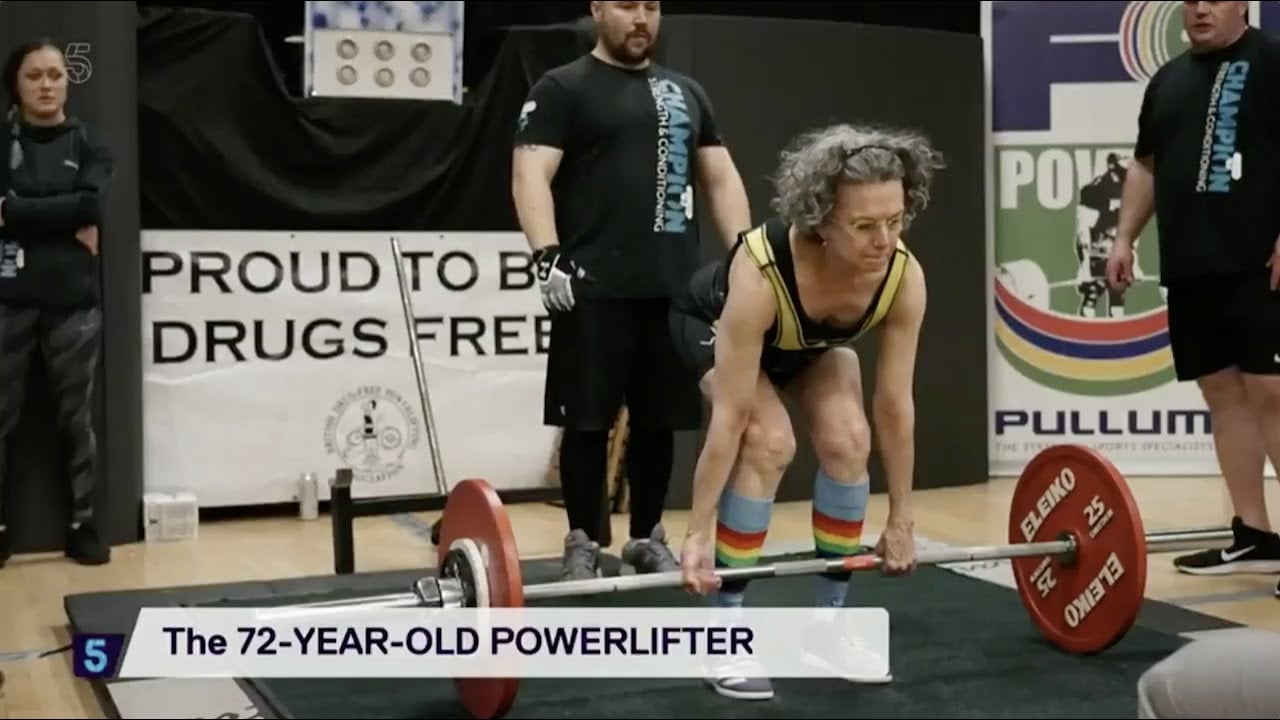
Dr Catherine Walter, Oxford University fellow, 2018 WDFPF World Champion · Watch her story.
2018 WDFPF World Championships
The Numbers Behind the World Title
Why This Happens
The Exercise Science Behind Strength Training and Ageing
Dr Walter’s story is remarkable — but it isn’t unexplained. The physiological responses behind it are well-documented in the exercise science literature, and they speak directly to why strength training may be one of the most important activities for older adults.
Bone Density & Mechanical Loading
Bone is a dynamic tissue that responds to mechanical load. Resistance training places stress on the skeletal system, which may stimulate osteoblast activity — the process by which new bone tissue is formed. Research suggests progressive resistance training is associated with maintained or improved bone mineral density in older adults, particularly in postmenopausal women.
Sarcopenia & Muscle Mass Preservation
After age 30, adults typically lose 3–5% of muscle mass per decade without adequate stimulus — a process called sarcopenia. Strength training is the most effective known intervention for slowing this loss. Preserving muscle mass supports metabolic function, joint stability, injury resilience, and functional independence as we age.
Neuromuscular Adaptations
Beyond muscle size, strength training improves the neuromuscular connection — how efficiently the brain recruits muscle fibres under load. In older adults, neuromuscular efficiency often declines before obvious muscle loss becomes apparent. Training preserves and may improve this capacity, contributing to better force production, balance, and movement control.
Cardiovascular & Metabolic Health
Resistance training may support healthy blood pressure, insulin sensitivity, and lipid profiles. Combined with its effects on body composition, progressive strength work contributes to a broadly positive metabolic environment — effects that compound over time with consistent training.
Cognitive & Psychological Effects
Research suggests resistance training may support cognitive function, mood regulation, and self-efficacy in older adults. The sense of physical capability that comes from progressive strength development has psychological dimensions that extend well beyond the training room.
Fall Prevention & Functional Independence
Improved lower limb strength, balance, and neuromuscular control are associated with reduced fall risk in older adults. Maintaining the physical capacity to move confidently and recover from perturbations may support functional independence well into later life.
“She didn’t start until 65. Within seven years, her bone density was equivalent to a 20-year-old’s. The body doesn’t have a fixed expiry date on adaptation — it has a response to stimulus.”
— Exercise Science Perspective · Heal Young Massage · Gold Coast
It’s Never Too Late
Five Reasons to Start Strength Training — Regardless of Age
The evidence supporting resistance training across the lifespan is substantial. Whether you’re 35 or 75, the physiological case for beginning — or returning to — structured strength work is compelling.
Adaptation doesn’t stop with age
The capacity for muscle hypertrophy, strength gain, and neuromuscular adaptation persists into very old age. The stimulus required may change, but the biology of adaptation remains intact. Dr Walter’s bone density result is an example of what consistent progressive loading may produce.
The costs of inactivity compound
Muscle and bone loss from sedentary ageing are not passive processes — they accelerate. The longer training is deferred, the larger the deficit to address. Starting now, at whatever starting point, is more valuable than waiting for ideal circumstances.
Functional capacity is the real measure
Competition lifts are one benchmark. The more relevant ones for most people are: can you carry groceries without discomfort, get up from the floor without assistance, walk stairs without holding the rail? These capacities are trainable and worth protecting deliberately.
Progressive overload works at every fitness level
The principle that drives world record powerlifting — gradually increasing the demand placed on the body — is exactly the same principle that works for someone beginning with bodyweight squats. The biology is identical. Only the load numbers differ.
Starting point doesn’t predict ceiling
Dr Walter had no powerlifting background before 65. The starting point is rarely informative about what becomes possible with consistent effort and appropriate progressive challenge. The ceiling is usually much higher than the entry point suggests.
Supporting the Training Process
How Remedial Massage May Support an Active Training Life
For those beginning or returning to strength training — particularly at an older age — the soft tissue demands of progressive loading can be significant. Connective tissue adapts more slowly than muscle, and asymmetric tension or restricted mobility can limit training quality and increase injury risk if not addressed.
Remedial massage, as part of a broader approach to training recovery, may support tissue pliability, address asymmetric loading patterns, and help maintain the movement range that progressive strength work requires. This is particularly relevant for:
New or Returning Strength Athletes
Tissue that hasn’t been under regular load often presents with restriction patterns that respond well to soft tissue work alongside progressive training. Addressing these early may support more consistent load tolerance.
Recovery Between Sessions
Soft tissue work between training sessions may support recovery quality, reduce perceived muscle soreness, and maintain tissue pliability — supporting the consistency that progressive training requires.
Movement Assessment & Asymmetry
An assessment-led session can identify bilateral tissue asymmetries and compensatory movement patterns before they become persistent. For older strength athletes, maintaining balanced loading on both sides of the body is particularly important.
If you’re starting or returning to strength training on the Gold Coast and want to build a soft tissue support programme around it, book an assessment session or read more about our remedial massage services.
Book a Session
Remedial Massage at
Heal Young Massage
Hill Yang · ESSA #17005 · MMA #031045

About the Author
Hill Yang
Hill has more than 20 years of clinical experience and over 25,000 hands-on sessions. He combines remedial massage with movement assessment, including force plate and motion-capture tools, to understand how load moves through the body. Hill was part of the medical team at the 2018 Commonwealth Games and is a finalist in the 2026 Australian Small Business Champion Awards (Health Improvement Services). He practises at Heal Young Massage in Varsity Lakes, Gold Coast, and offers sessions in English and Mandarin.