
A Personal Perspective
How a confirmed sceptic came around to dry needling
For years, people asked whether I practised acupuncture. My answer was always the same: no, and I had no interest in it. I liked the tactile feedback of hands-on work — the way you can feel tissue change under your hands in real time. The idea of inserting a needle and waiting for the body to self-regulate did not appeal to me.
That changed the day my mentor John explained the science behind dry needling. The mechanism was completely different from what I had assumed, and from that moment I became genuinely interested.
“The needle is the same. But what you are doing with it — and why — is a different clinical conversation entirely.”
My own clinical path had started with Traditional Chinese Medicine principles. When I began practising massage, the theory and technique I learned was largely rooted in TCM — meridian-based, energetic in framing. Over time I studied additional approaches: origin point therapy, Chinese corrective manual techniques, and meridian acupressure. All had value. But I also recognised a limitation: passive manual work, however skilled, has a ceiling. Genuine physical capacity requires active training, not just treatment.
Moving into Western evidence-based remedial massage opened up a different way of reading the body — anatomical, structural, and grounded in how tissue actually responds to load and movement. It was in this context that I also encountered fascia, and later, myofascial dry needling.
Understanding Fascia
The tissue that holds everything together
Fascia appears deceptively simple — a thin layer wrapping every muscle, organ, and structure in the body. Remove it and coordinated movement becomes impossible. Each muscle operates independently; fascia is what allows integrated, whole-body movement patterns to exist.
A Surprising Convergence
When ancient meridians and modern anatomy agree
In Tom Myers’ Anatomy Trains, Myers combined his anatomical expertise with input from TCM acupuncturists and found a striking correlation: the pathways of Chinese meridians closely correspond to the myofascial lines he had mapped through dissection.
One of the clearest examples is the Bladder Meridian in TCM and the Superficial Back Line in myofascial anatomy. Both run from the forehead down the back of the skull, along the spine, through the hamstrings and calves, and down to the sole of the foot. The myofascial line is somewhat broader in scope, but the correspondence is striking.
Because the Superficial Back Line runs as a continuous fascial system from forehead to sole, tension or restriction anywhere along its length may influence the whole. This is the anatomical basis for a principle that TCM practitioners understood empirically long before Western anatomy had the language for it. Treating the foot can, in certain contexts, influence tension patterns at the head and neck — because they share a continuous myofascial pathway.
This connection also explains why Hill’s 2015 graduation thesis at Massage Schools of Queensland focused on Dynamic Myofascial Release (DMR) — a technique that combines dynamic movement with myofascial input. Dynamic interventions consistently produce stronger and more durable responses than static ones, and understanding the fascial system provides a clear anatomical rationale for why.
The Core Difference
Same needle. Different conversation entirely.
The physical tool — a fine filiform needle — is identical in both approaches. What differs is the underlying model, the clinical reasoning, and what the practitioner is trying to achieve.
| Aspect | Traditional Acupuncture | Myofascial Dry Needling |
|---|---|---|
| Theoretical framework | TCM — qi, meridians, energetic balance | Neuromuscular anatomy — trigger points, fascia, neural response |
| Point selection | Based on meridian diagnosis and pattern identification | Based on palpation, movement assessment, and trigger point mapping |
| What happens after insertion | Needle left in place; body self-regulates | Active engagement — piston technique, fascial communication, twitch response |
| Primary target | Energetic/systemic balance via meridian pathways | Trigger point deactivation, local pH normalisation, neural inhibition |
| Training pathway | 5+ years full TCM qualification | Post-graduate course — requires existing health or massage qualification |
The Clinical Process
What happens during a dry needling session
Myofascial dry needling is not simply inserting a needle into wherever the discomfort is. The clinical reasoning begins before the needle is placed — because the presenting site of discomfort and the actual source of the dysfunction are frequently different locations.
-
Assessment first Identify where along the myofascial system the needle is needed — not just the painful area, but the pattern of restriction or trigger point activity contributing to it.
-
Communicating with superficial skin The needle first contacts the skin surface — the initial entry is a clinical communication, not just passage through tissue.
-
Engaging the fascia Fascia is simultaneously strong and responsive. In areas of dysfunction it may resist the needle — gripping, binding, or resisting movement in any direction. When this happens, the surrounding tissue needs to be addressed before the deeper target can be reached.
-
Reaching the target — muscle and nerve The primary goal is the affected muscle layer or adjacent neural structures. The aim is to elicit a local twitch response — the involuntary muscle contraction that signals trigger point engagement — and to facilitate the neurological reset that follows.
-
Supporting local recovery Research suggests dry needling may influence local pH and promote a recovery response in hyperirritable muscle tissue. The mechanism is distinct from acupuncture and is understood through neuromuscular physiology, not energetic frameworks.
Dry needling is classified as a neuromuscular technique. Neuromuscular approaches generally work quickly — specifically because the goal is to intervene before the nervous system has time to engage its protective or defensive response. If treatment is too slow, the brain mounts a defence and the therapeutic window closes. This is one area where needling can access tissue states that hands-on massage cannot.
Two Tools, Not One
Dry needling and massage are complementary, not competing
Myofascial dry needling is, in one sense, an extension of the practitioner’s hands — a tool that reaches layers of tissue and neural structures that manual pressure alone cannot access. It communicates with deep and superficial fascia, individual muscle fibres, and adjacent nerves.
Remedial massage, by contrast, works across broader areas of muscle tissue and superficial fascial layers, engaging the nervous system through sustained pressure, movement, and proprioceptive input.
Used together, they address different aspects of the same system. Neither replaces the other — they occupy different parts of the clinical toolkit, and the decision to use one or both depends on what the assessment reveals.
Hill completed his dry needling training under Jorgen — a Swedish physiotherapist with 23 years of experience — alongside qualified physiotherapists from Mater Hospital and an 18-year practising acupuncturist as assistant instructors. Feedback from both the physiotherapist and acupuncturist instructors on needle placement, tissue engagement, and post-session reassessment was positive across multiple practical assessment stages.
Book an Assessment
Understanding the tissue is the first step
Assessment-led treatment at Heal Young Massage begins with understanding what is actually happening in the body — before any technique is applied.
Educational content only. Not medical advice. Individual results vary. The information above describes myofascial dry needling as a technique and does not constitute a claim of treatment outcome for any condition. Always consult a qualified health professional for personal health concerns.
About the Author
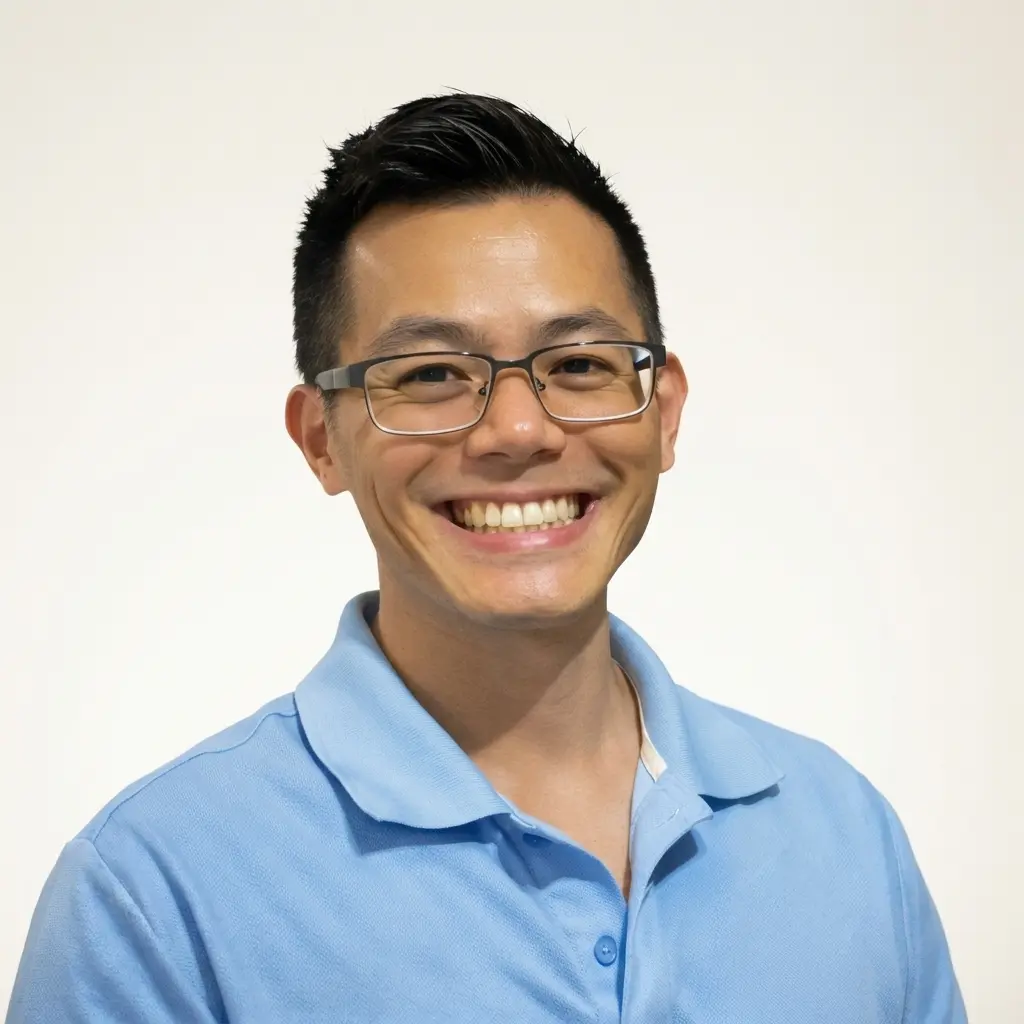
Hill Yang
Hill has more than 20 years of clinical experience and over 25,000 hands-on sessions. He combines remedial massage with movement assessment, including force plate and motion-capture tools, to understand how load moves through the body. Hill was part of the medical team at the 2018 Commonwealth Games and is a finalist in the 2026 Australian Small Business Champion Awards (Health Improvement Services). He practises at Heal Young Massage in Varsity Lakes, Gold Coast, and offers sessions in English and Mandarin.