What Is Cupping?
An ancient soft tissue technique using negative pressure — and one that went global in 2016 when the world noticed the circular marks on Michael Phelps’ shoulders. Here’s what it actually does, and why practitioners still use it.
What Is Cupping
What is cupping? Negative pressure therapy for soft tissue
What is cupping? In short: it is the application of negative pressure to soft tissue. A cup is placed against the skin and a vacuum is created inside it, drawing the skin and superficial fascia upward into the cup. This negative pressure — the opposite of the compressive force used in conventional massage — creates a different kind of mechanical stimulus in the tissue.
The technique has been used across Chinese, Middle Eastern, and Egyptian traditions for thousands of years, applied to acupuncture meridian lines, myofascial areas, and sites of local discomfort. How the cup is used varies. It can be left in place, or glided along the tissue — both of which are applied to a resting body. At this clinic it is more often used as myofascial cupping: the cup holds sustained decompression while you actively move through range. That difference matters, and it follows the same reasoning as Dynamic Myofascial Release (DMFR) — fascia treated in a still body behaves differently from fascia treated under active load.
At the 2016 Rio Olympics, swimmer Michael Phelps appeared on the pool deck covered in circular purple marks. Within hours, cupping went from a niche clinical tool to a global conversation. The marks are normal, temporary, and one of the most commonly asked questions about the technique.
The Mechanism
How cupping creates its effect
Creating the vacuum
A hand pump draws air out of the cup once it is placed on the skin. This gives precise, adjustable control over how much negative pressure is applied — cup by cup, and adjusted to the individual.
The negative pressure effect
The vacuum draws skin and fascia upward, creating tensile force through the superficial soft tissue layers — the opposite direction to the compression used in conventional massage.
Adding active movement
The decisive variable is not whether the cup moves — it is whether you do. With the cup holding decompression, active movement takes the fascia through range under load, which is where the deeper release occurs.
“Most manual therapy works by pushing into tissue. Cupping works by pulling it upward — creating a different mechanical vector through fascia, skin, and the structures beneath them.”
Types of Cupping
Passive applications — static and gliding
Fixed placement, body at rest
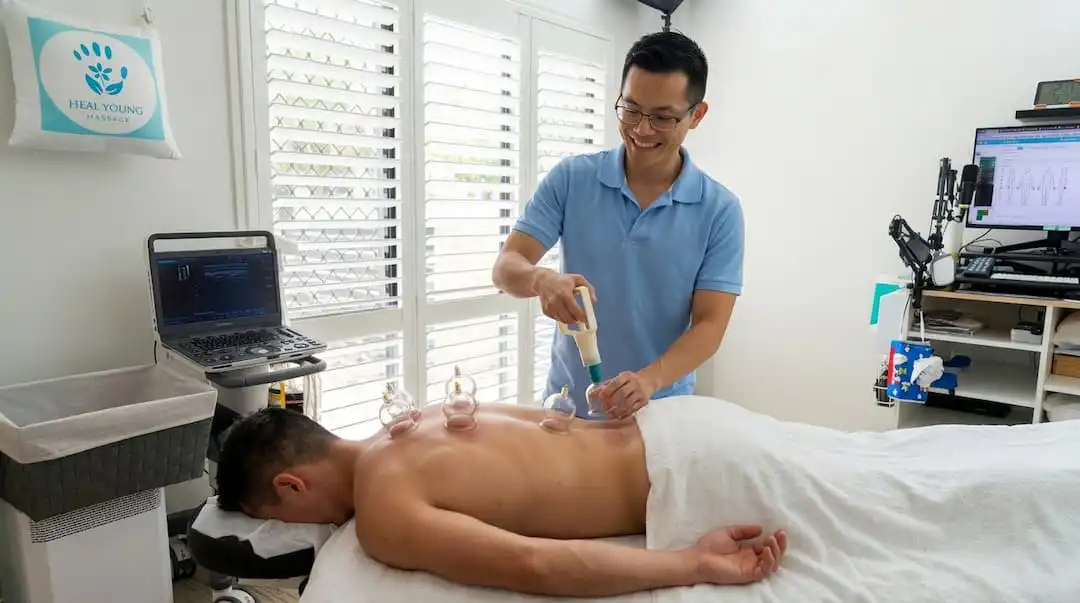
Cups are placed on specific areas and left in position for 5 to 15 minutes while you lie still. Used when targeting a localised area of tension or restriction. This is the method most people associate with the distinctive circular marks — and the one shown in the photograph above. Passive: the tissue is not being loaded during treatment.
The therapist moves the cup
Oil is applied to the skin, then the cup is glided along fascial lines and muscle groups rather than left stationary. This covers more surface area and leaves lighter marks, or none. Still passive, though — the cup travels, but the body stays at rest, so the tissue is not being treated under the loads it actually works under.
Note: wet cupping (which involves puncturing the skin) is not performed at this clinic. All cupping at Heal Young Massage is non-invasive — the skin is never broken.
Myofascial cupping — you move, the cup holds
Both methods above are passive. The cup does the work while the body rests. Myofascial cupping changes the variable that matters: the cup maintains sustained decompression over the target tissue, and you actively move through range while it does. The fascia is drawn upward and taken under load at the same time.
This is the same reasoning behind Dynamic Myofascial Release. Treating fascia only in a resting, unloaded position can produce relief that fades once the body returns to functional movement. Active engagement during treatment means the release happens at the tension level actually present during use — and keeps the nervous system engaged rather than settling into a passive, parasympathetic state it will leave the moment you stand up.
The movement is not incidental. It reveals where the fascial system catches under load in real time, and recruits the muscle during treatment — and activated muscle tolerates greater mechanical input than passive muscle does.
Cup or Hand
What the cup does that hands cannot — and the reverse
In myofascial cupping the cup takes the place of the hand. That is a trade-off rather than an upgrade, and which one is used depends on what the assessment finds.
The cup
Breadth
- Covers a larger superficial area than a hand can reach at once
- Applies decompression — lifting tissue rather than pressing into it
- Holds sustained, even tension hands-free, leaving both hands available to guide movement
- Suited to widespread superficial fascial restriction across a region
The hand
Depth and control
- Reaches deeper tissue layers than negative pressure can access
- Feels tissue response continuously and adjusts moment to moment
- Far more precise about angle, depth and direction of force
- Suited to a specific restriction that has been located and needs targeted work
In practice the two are often used in the same session — the cup to address a broad superficial region under active movement, hands to work the specific depth the assessment has identified.
The Five Functions
What cupping may do in soft tissue
Support local circulation and metabolic response
The negative pressure causes local vasodilation and may draw blood into the targeted area, creating the visible capillary response beneath the skin. This local circulatory change is one of the primary proposed mechanisms for the technique’s effect on tissue metabolism and recovery.
Fascial and connective tissue mobilisation
Cupping creates a sustained tensile force through the superficial fascia — a layer that conventional compression massage has limited access to. The lifting action may contribute to separating fascial adhesions and restoring glide between tissue layers, supporting range of motion in the targeted region.
Tissue elasticity and range of motion
By creating a sustained stretch through the skin, fascia, and underlying soft tissue, cupping may contribute to improved tissue extensibility in restricted areas. Some clients report improved local range of motion following cupping as part of a broader soft tissue session.
Addressing local tissue tension and restriction
In areas where muscular spasm, fascial tension, or adhesion is contributing to restricted movement or localised discomfort — such as chronic upper trapezius tension or thoracic restriction — cupping offers a decompressive approach that works alongside rather than in addition to compressive manual techniques.
Myofascial pain and sensitivity
Some clients with myofascial pain presentations — including tenderness, muscle fatigue, stiffness, and areas of referred sensitivity — report reduced local discomfort following cupping. The negative pressure creates a neurological response in the superficial fascia that may modulate pain sensitivity in the treated area. Individual responses vary.
The Evidence
What the research actually says about cupping
The five functions above are proposed mechanisms — what practitioners and researchers think is happening. It is worth being straightforward about how strong that evidence currently is, because the honest answer is: mixed, and weaker than the popularity of the technique suggests.
Where the evidence is reasonably supportive
Several systematic reviews report reductions in pain intensity following cupping, particularly for chronic low back and neck pain. A 2018 review and meta-analysis of chronic back pain found a significant reduction in reported pain scores, while noting there is no standardised treatment protocol across studies.[1] A 2021 evidence map covering thirteen systematic reviews found potential benefit across conditions including low back pain, neck pain and knee osteoarthritis.[2]
Where it is weaker, or unclear
A 2019 systematic review comparing manual therapy, dry needling and cupping for myofascial pain concluded that the evidence for cupping was not greater than placebo, and that only two cupping studies met the inclusion criteria at all.[3] A 2025 meta-analysis comparing cupping against sham cupping noted that the mechanisms of pain relief remain unknown, and that a placebo contribution cannot be ruled out.[4] Reviews consistently flag small sample sizes, absent blinding and high risk of bias across the literature.
What that means for your treatment
Cupping is not offered here as a solution to a diagnosed condition, and it is not the reason a session works. It is one input among several, chosen when the assessment suggests broad superficial fascial restriction is part of the picture. Notably, trials combining cupping with other therapies — exercise, massage — have tended to report better outcomes than those testing cupping in isolation.[5] That matches how it is used in this clinic: as an adjunct within an assessment-led session, not as a standalone protocol.
- Moura CC, et al. (2018). Cupping therapy and chronic back pain: systematic review and meta-analysis. Revista Latino-Americana de Enfermagem, 26, e3094. PMC6248735
- Choi TY, Ang L, Ku B, Jun JH, Lee MS. (2021). Evidence Map of Cupping Therapy. Journal of Clinical Medicine, 10(8), 1750. PMC8073851
- Charles D, Hudgins T, MacNaughton J, Newman E, Tan J, Wigger M. (2019). A systematic review of manual therapy techniques, dry cupping and dry needling in the reduction of myofascial pain and myofascial trigger points. Journal of Bodywork and Movement Therapies, 23(3), 539–546. PubMed 31563367
- The Efficacy of Dry Cupping Compared to Placebo Cupping for People With Musculoskeletal Complaints: A Systematic Review With Meta-Analysis (2025). JOSPT Open. JOSPT Open
- Update evidence of effectiveness on pain relieving of cupping therapy: a systematic review and meta-analysis of randomized controlled trials (2025). PMC11955767
About the Marks
What the circles actually are
The most asked question about cupping. The circular discolouration left by static cupping is caused by the negative pressure drawing blood into the capillaries beneath the skin — in some cases causing capillary rupture under the surface. They are not bruises in the conventional sense (caused by blunt trauma) and are generally not painful to touch.
Colour and what it may indicate
In traditional Chinese medicine, mark colour is used as a diagnostic indicator of tissue state. In contemporary practice, it is understood as a reflection of local tissue response to negative pressure.
How long do they last?
Marks typically resolve within 3 to 7 days, depending on the depth of the response and the individual’s circulation. Darker marks may take slightly longer.
Gliding and myofascial cupping produce lighter marks or none at all, because prolonged suction is never held over a single point.
Are they painful?
The marks are generally not painful to touch, even when they appear dark. During the session, there is a pulling sensation — the pressure is adjusted to your tolerance and comfort throughout.
Suitability
Who cupping may be suitable for
May be suitable
Upper back and neck tension
One of the most common applications — persistent thoracic and cervical restriction that has responded poorly to compression massage alone.
May be suitable
Fascial restriction patterns
Where superficial fascial adhesion is contributing to movement limitation or regional tightness — the decompressive action of cupping addresses a layer that compression cannot reach effectively.
May be suitable
Athletic recovery
Used alongside other remedial techniques for athletes managing training load — particularly for thoracic, hip flexor, and posterior chain presentations.
May be suitable
Chronic myofascial pain areas
Where long-standing tension and sensitivity in specific areas has not responded to conventional massage pressure, cupping offers a different mechanical input to the tissue.
Contraindicated / discuss first
Skin conditions, open wounds, sunburn
Cupping should not be applied to broken, inflamed, or significantly compromised skin. Active eczema, psoriasis, or similar conditions in the treatment area are a contraindication.
Contraindicated / discuss first
Blood thinners, clotting disorders, pregnancy
Those on anticoagulant medication, with clotting disorders, or who are pregnant should discuss with their treating practitioner before cupping is performed.
Interested in cupping
as part of your treatment?
Mention it when you book, or ask during your assessment. Treatment is selected based on what will be most useful for your specific presentation.
This post is intended as general health information about cupping therapy. The proposed mechanisms and functions described reflect current clinical understanding and traditional practice contexts. Cupping is not a standalone treatment for any medical condition and should be used as part of an individually assessed remedial massage session. Clinical photography shared with client consent. If you are unsure whether cupping is appropriate for your condition, please consult a qualified health professional. Individual responses to treatment vary.

About the Author
Hill Yang
Hill has more than 20 years of clinical experience and over 25,000 hands-on sessions. He combines remedial massage with movement assessment, including force plate and motion-capture tools, to understand how load moves through the body. Hill was part of the medical team at the 2018 Commonwealth Games and is a finalist in the 2026 Australian Small Business Champion Awards (Health Improvement Services). He practises at Heal Young Massage in Varsity Lakes, Gold Coast, and offers sessions in English and Mandarin.