Movement Assessment · Sports Performance
Leg Strength Asymmetry:
What Force Plate Data Reveals
Most people assume their legs are working equally. Force plate data consistently shows otherwise — and the difference matters for performance, injury risk, and long-term joint health.

Why Asymmetry Matters
Your body is compensating. You just can’t see it.
Side-to-side leg strength imbalances are one of the most common — and most overlooked — contributors to recurring injury and reduced athletic output. The challenge is that the human eye cannot detect a 10–15% loading difference between limbs during walking or running. By the time a compensation pattern is visually obvious, it has typically been present for months or years.
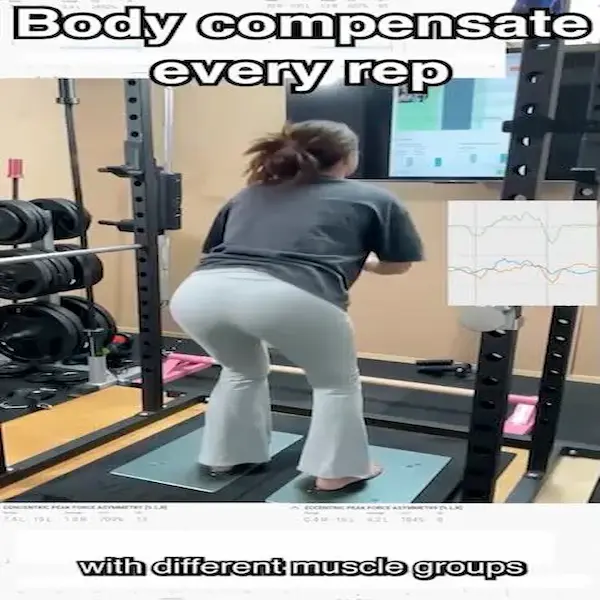
Force plate assessment changes that. By measuring the exact distribution of weight through each foot during standing, movement, and loading tasks, it becomes possible to quantify asymmetry precisely and track how a session influences those patterns.
“A 17% asymmetry during standing may feel normal — because the nervous system has adapted to it over time. That adaptation comes at a cost.”
The hip, knee, and ankle do not operate in isolation. A restriction at the hip changes loading at the knee. Altered ankle mechanics shift force distribution throughout the entire chain. This is why assessment at multiple joints — not just the site of discomfort — gives a more complete picture of what is actually happening.
Session Observations
Force plate recordings: before and after a single session
The following figures were recorded using objective force plate measurement at the start and end of a one-hour assessment and treatment session. Individual results vary.
Asymmetry measured as % excess load shifted to right versus left leg during static bilateral stance.
Asymmetry recorded at the lowest point of a bilateral deep squat — the position of maximum loading demand on the hip, knee, and ankle.
Clinical Context
What these numbers actually mean in practice
A 37% asymmetry at the base of a squat means the right hip, knee, and ankle are absorbing significantly more force than the left with every repetition, every stride, and every landing. Over thousands of repetitions in training or sport, that differential accumulates.
Reducing that asymmetry does not automatically resolve all musculoskeletal concerns — but it changes the loading environment substantially. Joints that have been absorbing excess force get a different mechanical input. Tissues that have been underloaded on the opposing side are required to engage. The nervous system receives updated proprioceptive information about where the body is in space.
The deep squat is a high-demand loading task that reveals asymmetries that bilateral standing may not capture. At the lowest point, the hip, knee, and ankle are at or near end range simultaneously — meaning any restriction in one joint immediately redistributes force to the others. A 37% right-sided asymmetry at this position suggests meaningful restriction somewhere along the left kinetic chain.
What’s Involved
Hip, knee, and ankle: a three-joint assessment
Leg strength balance assessment at Heal Young Massage involves evaluation of the full lower limb kinetic chain. Force plate data provides the objective load-distribution picture; hands-on assessment identifies the contributing soft tissue and joint factors.
Hip Assessment
Mobility, rotation patterns, and gluteal loading strategies. The hip is the most common source of downstream asymmetry in the lower limb.
Knee Assessment
Valgus/varus tendencies, patellar tracking, and quadriceps-to-hamstring balance under load.
Ankle Assessment
Dorsiflexion range, subtalar mechanics, and the relationship between ankle restriction and compensatory knee and hip loading.
Force Plate Data
Objective measurement of bilateral loading during standing, squatting, and functional movement tasks — before and after the session.
Who This Is For
Leg strength balance assessment may be relevant for
- Athletes seeking performance data — asymmetry between limbs affects power output, running economy, and the ability to absorb ground reaction force efficiently. Quantifying and reducing it is a practical component of performance work.
- People with recurring lower limb injuries — if the same side keeps getting injured, the loading pattern is often a contributing factor. Assessment provides a starting point for understanding why.
- Chronic back or leg pain — prolonged asymmetric loading frequently contributes to lumbar, hip, and knee discomfort. Addressing the load distribution through the lower limb is part of managing the broader pattern.
- Post-surgical or post-injury rehab — returning to full bilateral symmetry after an injury or procedure is rarely automatic. Force plate measurement provides an objective way to track where loading has and hasn’t normalised.
- People who stand or walk extensively — occupational and lifestyle loads accumulate over time. A baseline measure of bilateral symmetry is useful information regardless of current symptom status.
Assessment Rationale
What visual observation cannot tell you
Experienced clinicians can identify obvious gait asymmetries visually. But a 17% loading asymmetry during standing — or even 37% at the base of a squat — is not visible to the naked eye in most people. The body is remarkably good at distributing compensation across multiple joints and planes of movement so that no single joint gives itself away.
Force plate data removes the guesswork. It makes the invisible visible: which leg is carrying more load, under which conditions, and by how much. That information changes the specificity of both assessment and session planning.
Book an Assessment
Find out what your force plate data looks like
Leg strength balance assessment is available at Heal Young Massage, Varsity Lakes. Sessions include hip, knee, and ankle evaluation with objective force plate measurement.
Educational content only. Not medical advice. Individual results vary. Force plate data presented reflects a single session observation and is not representative of typical or guaranteed outcomes. Always consult a qualified health professional for personal health concerns.

About the Author
Hill Yang
Hill has more than 20 years of clinical experience and over 25,000 hands-on sessions. He combines remedial massage with movement assessment, including force plate and motion-capture tools, to understand how load moves through the body. Hill was part of the medical team at the 2018 Commonwealth Games and is a finalist in the 2026 Australian Small Business Champion Awards (Health Improvement Services). He practises at Heal Young Massage in Varsity Lakes, Gold Coast, and offers sessions in English and Mandarin.