Movement & Biomechanics · Gold Coast
Real-Time Balance and Squat Movement:
What Force Plate Data Reveals
Balance and squat movement are fundamental to how we move through daily life. From sitting and standing to lifting, walking, and returning to sport, the squat pattern reflects how the body coordinates strength, balance, and control under load. Most practitioners observe this visually. At Heal Young Massage, we record it in real time.
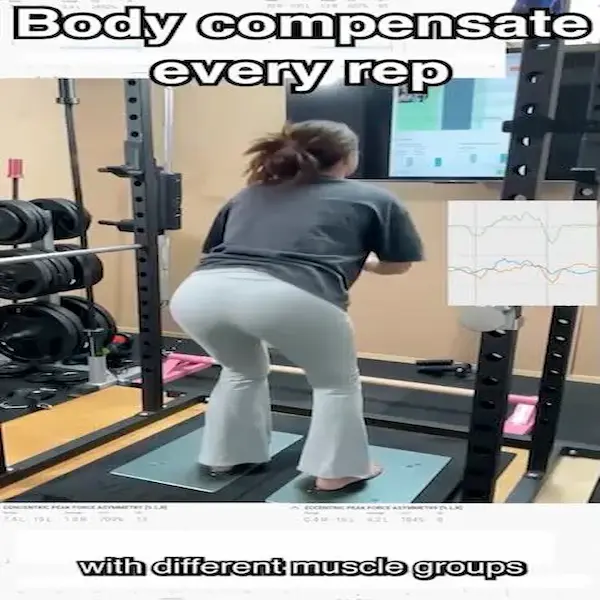
The video below captures a squat assessment on force plates, with the client’s live data displayed on screen as they move. The focus is not on how much weight is being lifted — it is on how the movement is organised: weight distribution through the feet, control of the hips and trunk, and coordination during both the descent and return phases.
Why the squat pattern matters
The squat is one of the most revealing movement patterns in clinical assessment. It demands simultaneous coordination from the ankles, knees, hips, pelvis, and spine — and any restriction or asymmetry in that chain tends to show up clearly under load. Someone who looks relatively unrestricted standing still may reveal significant asymmetry the moment they descend into a squat, particularly as depth increases.
“What the body does under load is rarely what it appears to do at rest. The squat is one of the fastest ways to see the difference.”
This matters clinically because compensation patterns developed in the squat often mirror compensation patterns in everyday movement — stairs, sitting to standing, lifting, walking uphill. Identifying them objectively, rather than through visual estimation alone, changes what gets addressed in the session.
This assessment: left hip, right shoulder
In this particular recording, the primary areas of interest identified during the assessment were a left hip restriction and a right shoulder pattern — two regions that appear unrelated but are often connected through the diagonal fascial chains that run through the trunk. When the left hip is restricted, the body frequently adapts through the contralateral shoulder and thoracic region to maintain balance during loaded movement.
What force plate data shows that visual observation cannot
Force plates measure ground reaction force — the force the feet exert downward, and what the ground pushes back. During a squat, this data shows weight distribution between left and right at every point in the movement, not just at the bottom. A client can appear symmetrical to the eye while offloading one side by 15–20% throughout the entire descent. That asymmetry is invisible without data and may not produce pain yet — but it will produce wear over time.
Assessment recording — Gold Coast clinic
Real-time balance and squat movement captured during a controlled functional task, focusing on stability, coordination, and movement quality.
Force plate squat and balance assessment — Heal Young Massage, Varsity Lakes, Gold Coast. Left hip and right shoulder involvement observed during controlled functional task.
Shared with client consent. Individual results vary.
- Weight distribution left vs right throughout the descent
- Hip position and control at the base of the movement
- Trunk behaviour during both lowering and standing phases
- Timing differences between left and right sides
- How the system compensates to maintain balance
- Real-time force data displayed on the assessment screen
The movement-informed approach
At Heal Young Massage, hands-on treatment is guided by how the client moves — not by a list of symptoms. The assessment comes first, the treatment follows from what it reveals. When a squat assessment identifies left hip restriction contributing to right shoulder compensation, the session addresses that chain — not just whichever area is currently producing discomfort.
This approach is commonly used to support:
- Active adults and athletes looking to move more efficiently and reduce accumulated asymmetry
- People with ongoing stiffness or discomfort that hasn’t fully responded to single-area treatment
- Clients returning to exercise who want objective data on movement quality before loading up
- Anyone wanting to understand how their body actually moves, not just how it feels
For athletes specifically — including those pursuing golf performance or training toward event goals — load asymmetry in the squat pattern often limits power output and increases injury risk long before any pain appears. The force plate makes this visible at a point where it is still easy to address.
You can read more about how real-time squat data informs clinical decisions in the companion article: What force plate data reveals that visual assessment cannot.
If you’re on the Gold Coast and want to understand how you move under load — whether you’re managing back pain, returning to training, or simply curious — a movement and fascial restriction assessment is where that conversation starts.
Want to see how you move?
Book a force plate squat and movement assessment at Varsity Lakes — or start with an online movement assessment from anywhere.
Educational content only. Not medical advice. Assessment footage shared with client consent. Individual results vary. Always consult a qualified health professional for personal health concerns.

About the Author
Hill Yang
Hill has more than 20 years of clinical experience and over 25,000 hands-on sessions. He combines remedial massage with movement assessment, including force plate and motion-capture tools, to understand how load moves through the body. Hill was part of the medical team at the 2018 Commonwealth Games and is a finalist in the 2026 Australian Small Business Champion Awards (Health Improvement Services). He practises at Heal Young Massage in Varsity Lakes, Gold Coast, and offers sessions in English and Mandarin.