
Why This Matters
The hand is one of the most neurologically complex structures in the body
The hand depends on precise nerve function to coordinate movement, generate grip strength, and register sensation. Three peripheral nerves — the median, ulnar, and radial — share responsibility for this, each supplying a distinct group of muscles and a defined area of sensation.
When a nerve is injured, stretched, or compressed over time, the muscles it supplies can lose power. This doesn’t always present as obvious pain — it may show up as weakness, a subtle loss of coordination, or a hand that fatigues faster than it should. Identifying which nerve is involved helps direct the right assessment and appropriate care.
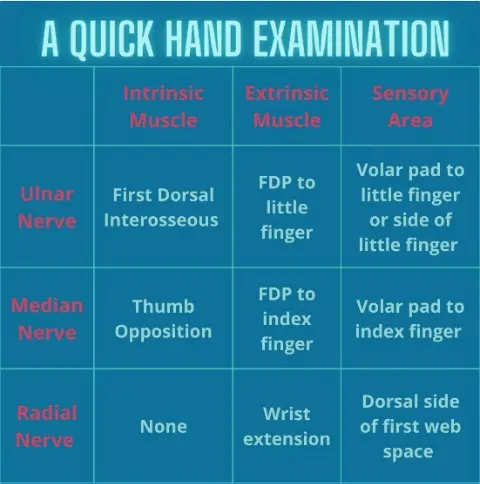
The diagram and tests below — adapted from resources including the Australian Hand Therapy Association (AHTA) — offer a structured way to screen the three main nerves and the muscles they supply.
The Three Nerves
Muscle supply and sensory distribution
Median Nerve
C6 – T1 · Palmar surface · Thumb to ring finger
Thenar Muscles
- Abductor pollicis brevis
- Opponens pollicis
- Flexor pollicis brevis (superficial head)
Other Muscles
- 1st & 2nd lumbricals
- Flexor digitorum superficialis
- Flexor digitorum profundus (digits 2–3)
- Pronator teres & quadratus
Sensory Area
- Palmar surface: thumb, index, middle finger
- Lateral half of ring finger
- Dorsal fingertips: index, middle, lateral ring
Ulnar Nerve
C8 – T1 · Medial hand · Little and ring finger
Hypothenar Muscles
- Abductor digiti minimi
- Flexor digiti minimi brevis
- Opponens digiti minimi
Other Intrinsics
- All interossei (dorsal & palmar)
- 3rd & 4th lumbricals
- Adductor pollicis
- Flexor pollicis brevis (deep head)
Sensory Area
- Palmar & dorsal: little finger
- Medial half of ring finger
- Medial palm and dorsum of hand
Radial Nerve
C5 – T1 · Dorsal surface · Primarily sensory in hand
Wrist & Forearm
- Extensor carpi radialis longus & brevis
- Extensor carpi ulnaris
- Extensor digitorum
- Supinator
Thumb & Fingers
- Abductor pollicis longus
- Extensor pollicis longus & brevis
- Extensor indicis
- Extensor digiti minimi
Sensory Area
- Dorsal surface of thumb
- Dorsal index and middle fingers (proximal)
- Dorsal lateral hand (superficial branch)
“If nerves are injured or compressed for a long period of time, it can decrease the power supply to the muscles in the hand. This quick test can check the main muscles supplied by these nerves.”
When Nerves Are Compressed
Common compression presentations
Each nerve has specific sites along its path where compression is more likely to occur. Knowing which nerve is involved — and where — helps identify the most useful areas for assessment.
Median Nerve
Carpal Tunnel Syndrome
Compression at the wrist under the flexor retinaculum. Associated with thenar wasting, numbness in the thumb and index finger, and reduced grip strength.
Ulnar Nerve
Cubital / Guyon’s Canal
Compression at the elbow (cubital tunnel) or at the wrist (Guyon’s canal). Associated with interossei weakness, ring and little finger numbness, and difficulty with fine motor tasks.
Radial Nerve
Radial Tunnel / Wrist Drop
Compression in the radial tunnel or at the spiral groove of the humerus. Associated with wrist extension weakness, dorsal hand numbness, and difficulty with grip initiation.
Quick Assessment Tests
Screening the three nerves
These functional tests provide a rapid screen of the muscles supplied by each nerve. They are intended as observational checks — not diagnostic tools — and should be considered alongside a full clinical assessment.
OK Sign Test
Median Nerve — Anterior Interosseous Branch
Ask the person to form an “OK” sign with their thumb and index finger, creating a circular loop. The test screens the flexor pollicis longus and flexor digitorum profundus to the index finger.
Positive finding: Inability to form a circle — the fingers pinch in a straight “pinch” position rather than a loop — may suggest anterior interosseous nerve involvement.
Froment’s Sign
Ulnar Nerve — Adductor Pollicis
Ask the person to hold a piece of paper between their thumb and index finger while you attempt to pull it away. The adductor pollicis (ulnar) holds the thumb straight; the flexor pollicis longus (median) compensates by flexing the thumb IP joint.
Positive finding: Visible flexion of the thumb IP joint during the pinch may indicate adductor pollicis weakness, suggesting ulnar nerve involvement.
Wrist & Finger Extension
Radial Nerve — Posterior Interosseous Branch
Ask the person to extend the wrist and fully extend all fingers against light resistance. This screens the extensor digitorum, extensor carpi radialis, and extensor carpi ulnaris.
Positive finding: Weakness or inability to extend the wrist or fingers against resistance may suggest posterior interosseous nerve or radial nerve involvement.
Reference Diagram
Nerve distribution map — AHTA
The diagram below, sourced from the Australian Hand Therapy Association (AHTA), illustrates the sensory and motor distribution of the three main hand nerves. It is a useful visual reference when mapping symptoms to a likely nerve territory.
“Peripheral nerves travel through soft tissue tunnels. When the surrounding structures — muscles, fascia, tendons — become restricted, the nerve’s capacity to glide and function can be affected. Addressing the tissue environment is part of the assessment picture.”
Clinical Context
Soft tissue and nerve function
Remedial massage assessment includes evaluating the soft tissue structures through which peripheral nerves travel. Restrictions in the forearm, wrist, or palm — whether muscular, fascial, or tendinous — can contribute to the mechanical environment around a nerve.
When hand or wrist symptoms are present, a thorough assessment considers not only the hand itself but the broader kinetic chain: cervical spine, thoracic outlet, elbow, and forearm. Nerve compression is often a regional presentation rather than a purely local one.
If you’re experiencing hand weakness, numbness, or grip issues, an assessment through a qualified practitioner is the appropriate first step. The tests described here are useful as a starting reference — but clinical decision-making requires a full individual assessment.
Hand or wrist concerns?
Let’s assess it properly.
An assessment-led approach means looking at the whole picture — not just where the symptoms are. Book in and we’ll work through it together.
This post is intended as general health information only. The assessment tests described are observational screens and do not constitute a clinical diagnosis. If you are experiencing hand weakness, numbness, or other symptoms, please consult a qualified health professional for an individualised assessment. Individual presentations vary and results of any intervention cannot be guaranteed.

About the Author
Hill Yang
Hill has more than 20 years of clinical experience and over 25,000 hands-on sessions. He combines remedial massage with movement assessment, including force plate and motion-capture tools, to understand how load moves through the body. Hill was part of the medical team at the 2018 Commonwealth Games and is a finalist in the 2026 Australian Small Business Champion Awards (Health Improvement Services). He practises at Heal Young Massage in Varsity Lakes, Gold Coast, and offers sessions in English and Mandarin.


