Who Should I See if I Experience Pain or Injury?

Health Information Pain Relief Massage August 2022

Who Should I See if I Experience Pain or Injury?

Physio, chiro, osteo, OT, or remedial massage — there’s no single right answer. The right choice depends on the type of pain, how long it has been present, and what you actually need from treatment. Here’s a practical guide.

5 Professions covered
Type of pain determines choice
Duration acute vs chronic matters
Assessment-Led Remedial massage at HYM

Understanding Which Health Professional Is Right for You

When pain or injury appears, the Australian healthcare landscape offers several different entry points — and the choice between them isn’t always obvious. Physiotherapists, chiropractors, osteopaths, occupational therapists, and remedial massage therapists each operate from different clinical frameworks, hold different scopes of practice, and are better suited to different types of problems.

The decision is rarely about which profession is “best.” It’s about which approach is most aligned with what your body actually needs at this point in time. For some presentations — an acute ankle sprain, post-surgical rehabilitation, or neurological symptoms — the right referral matters significantly. For others, the distinction is less critical, and multiple professions may offer similar benefit.

What follows is a straightforward guide to each profession, who they tend to be most useful for, and how they fit together when managing pain or recovering from injury.
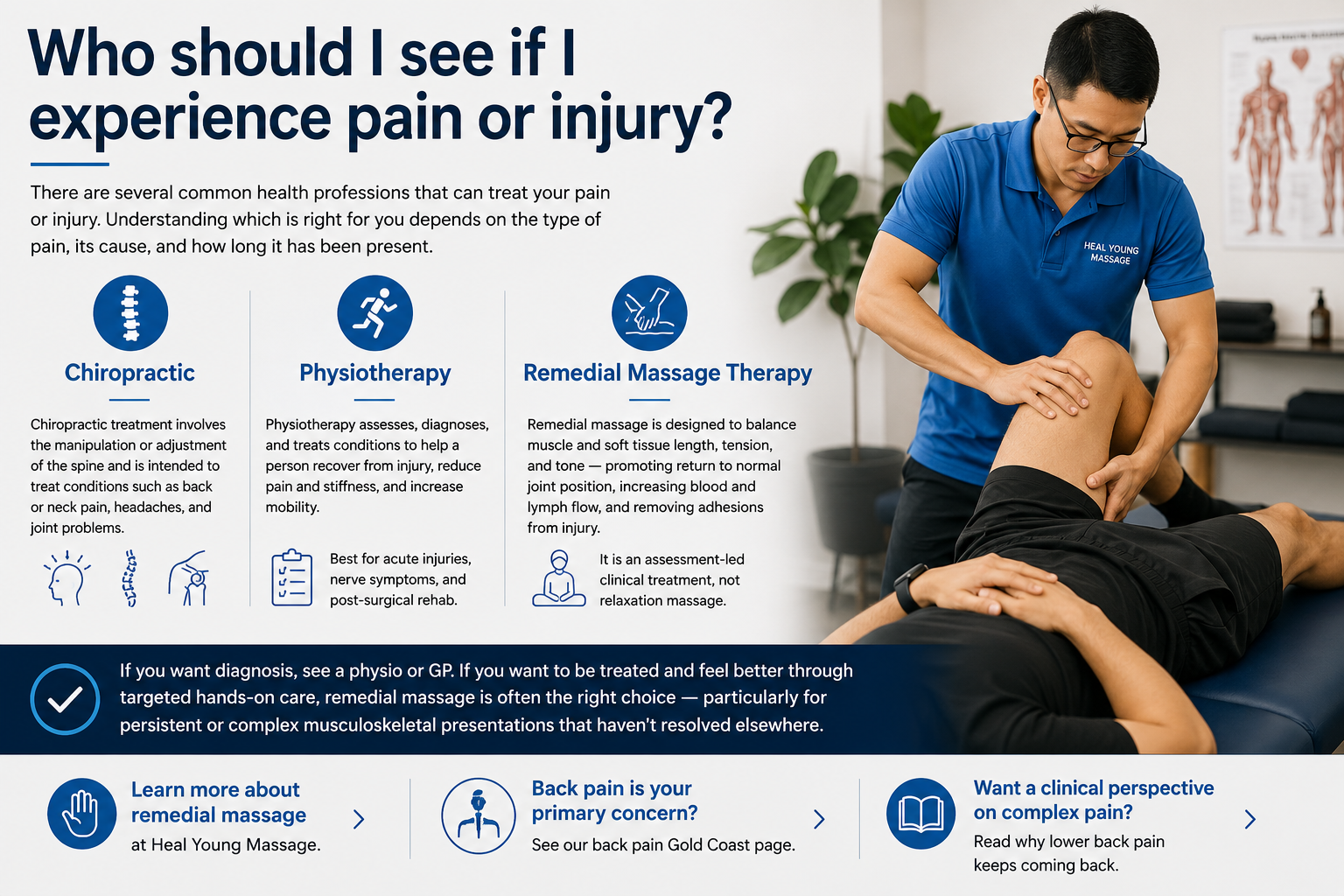
Who should I see if I experience pain or injury — Physio, Chiro, Osteo, OT, Remedial Massage guide
Choosing the right health professional depends on the type of pain, its cause, and how long it has been present. — Heal Young Massage, Varsity Lakes.

What Each Discipline Does — and When It Tends to Help Most

🩺
First Stop

General Practitioner (GP)

Before choosing any allied health professional, a GP consultation is worthwhile if your pain is unexplained, severe, sudden in onset, accompanied by neurological symptoms (numbness, tingling, weakness), or has not responded to treatment. GPs can arrange imaging, refer to specialists, and rule out medical causes of pain that require a different pathway entirely.

This doesn’t mean you need a GP referral before seeing an allied health professional — most professions below can be accessed directly. But if there’s any uncertainty about whether the pain has a medical origin, a GP is the right starting point.

Consider First When
Unexplained or sudden severe pain Neurological symptoms Red flag indicators Need for imaging or specialist referral
🏃
Physiotherapy

Physiotherapist

Physiotherapists are university-trained allied health professionals who assess, diagnose, and manage conditions affecting movement and function. They work across musculoskeletal, neurological, cardiorespiratory, and post-surgical presentations. In Australia, physiotherapists are registered with AHPRA and hold the scope to provide a clinical diagnosis.

Physiotherapy is particularly well-suited to acute injuries, nerve root presentations (sciatica, radiculopathy), post-operative rehabilitation, and cases requiring structured progressive exercise prescription. Many physiotherapists also provide hands-on manual therapy alongside exercise-based management.

Best Suited For
Acute musculoskeletal injuries Post-surgical rehab Nerve root symptoms Exercise prescription Neurological conditions
🦴
Chiropractic

Chiropractor

Chiropractors are AHPRA-registered practitioners whose primary approach involves spinal manipulation and adjustment — a high-velocity, low-amplitude thrust technique aimed at restoring spinal joint movement. Chiropractic care is most commonly sought for back pain, neck pain, headaches, and joint-related complaints, and many chiropractors also incorporate soft tissue work and rehabilitation exercises.

The evidence base for spinal manipulation in acute low back pain is reasonably well-established. Its role in chronic or complex pain presentations is more varied, and outcomes depend significantly on the specific presentation and practitioner approach.

Best Suited For
Back & neck pain Headaches Spinal joint mobility Joint-related complaints
🤲
Osteopathy

Osteopath

Osteopaths are AHPRA-registered practitioners who take a whole-body approach to musculoskeletal assessment and treatment. Osteopathic treatment draws on a range of manual techniques — including soft tissue work, joint mobilisation, and spinal manipulation — with an emphasis on the relationship between the body’s structure and its overall function.

Osteopathy tends to suit people who prefer a broader, systems-based approach to their pain or injury, and those with presentations that span multiple body regions. Like physiotherapy, osteopathy can include exercise-based management alongside hands-on treatment.

Best Suited For
Whole-body approach Multi-region complaints Joint mobilisation Structural assessment
🔧
Occupational Therapy

Occupational Therapist (OT)

Occupational therapists focus on enabling participation in daily activities and occupations — work, self-care, leisure — when illness, injury, or disability has affected a person’s ability to engage with them. OTs assess the interaction between a person, their activities, and their environment, and may provide equipment, environmental modification, rehabilitation strategies, and return-to-work support.

OT is particularly relevant for complex injury presentations affecting daily function, WorkCover or NDIS contexts, upper limb conditions limiting hand and arm use, and situations where the goal is functional participation rather than pain reduction alone.

Best Suited For
Functional participation goals Return to work Upper limb conditions NDIS / WorkCover Environmental modification
🙌
Remedial Massage Therapy

Remedial Massage Therapist

Remedial massage is a hands-on clinical treatment focused on the soft tissue system — muscles, tendons, fascia, and associated connective tissue. It is assessment-led, not relaxation-based. A remedial massage therapist assesses movement, tissue quality, and load patterns before applying targeted techniques to address the specific soft tissue findings.

The role of remedial massage is to support balanced soft tissue length, tension, and tone; to improve circulation and lymphatic flow in affected areas; to address fascial restrictions and adhesions; and to reduce compensatory loading patterns that contribute to pain or reduced mobility. It is particularly suited to persistent or recurring musculoskeletal presentations, soft tissue components of complex pain, and as a complement to physiotherapy or other medical management.

Remedial massage therapists do not diagnose medical conditions and do not replace the role of physiotherapists or medical practitioners in presentations requiring clinical diagnosis. If you need a diagnosis, see a physiotherapist or GP. If your need is targeted hands-on clinical treatment of the soft tissue system, remedial massage is often the right choice.

Best Suited For
Soft tissue assessment & treatment Persistent or recurring pain Fascial restriction Athletic recovery Postural tension Complement to physio / medical care

“The question isn’t which profession is better. It’s which approach matches what your body actually needs at this point in time — and that depends on the type of pain, its cause, and what has and hasn’t worked before.”

— Hill Yang · Remedial Massage Therapist & Exercise Scientist · ESSA #17005 | MMA #031045

Match Your Situation to the Right Starting Point

“I’ve had a recent acute injury and the pain is significant.”
Start with a physiotherapist or your GP for assessment and diagnosis.
“I have numbness, tingling, or weakness going into my arm or leg.”
See a GP or physiotherapist first to assess for nerve involvement.
“My back pain keeps coming back after treatment.”
Remedial massage or physio — an assessment looking beyond the symptomatic site may identify what’s been missed.
“I have persistent neck, back, or joint pain and want hands-on care.”
Physiotherapy, osteopathy, chiropractic, or remedial massage — all relevant. The best fit depends on your preference for approach.
“I’ve had surgery and need to regain function and strength.”
Start with physiotherapy for structured post-surgical rehabilitation. Remedial massage can complement this at appropriate stages.
“I need help getting back to work or daily activities after injury.”
An occupational therapist is the most directly relevant profession for functional participation goals.
“I’m an athlete with tight muscles, asymmetries, or recurring niggles.”
Remedial massage with an assessment-led approach is well-suited — particularly for soft tissue components and kinetic chain patterns.
“I’m not sure what’s wrong — the pain doesn’t have a clear explanation.”
Start with your GP to rule out medical causes, then consider a physiotherapy or remedial massage assessment for functional evaluation.

When Multiple Professions Make Sense Together

For complex, persistent, or high-stakes presentations, a single-discipline approach may not address the full picture. Several combinations tend to work particularly well:

Physio + Remedial Massage

Physiotherapy manages the diagnosis, exercise prescription, and staged loading plan. Remedial massage addresses the soft tissue components — fascial restriction, bilateral asymmetry, tissue quality — that hands-on physio may not cover in a standard session.

GP + Allied Health

GP provides imaging, diagnosis, and rules out medical causes. Allied health (physio, remedial massage, or OT) then takes the functional rehabilitation forward with the clinical picture in place.

OT + Physio or Massage

Occupational therapy addresses the functional and environmental dimensions of recovery. Physiotherapy or remedial massage address the physical capacity and soft tissue dimensions — complementary goals rather than competing ones.

What Remedial Massage Can and Cannot Do

Understanding the scope of remedial massage helps set the right expectations. At Heal Young Massage, every session begins with an assessment — movement screening, bilateral palpation, and kinetic chain evaluation — before any hands-on work. This is clinical remedial massage, not relaxation treatment.

Remedial Massage Can:

  • Assess movement quality, tissue tension, and bilateral asymmetry
  • Apply targeted soft tissue techniques to address specific findings
  • Support circulation and lymphatic flow in affected areas
  • Address fascial restrictions and adhesions across the kinetic chain
  • Complement physiotherapy and medical management
  • Monitor tissue changes over time with objective reassessment
  • Use VALD ForceDecks force plate analysis to quantify asymmetries
  • Provide soft tissue management for athletes in training and competition

Remedial Massage Cannot:

  • Diagnose medical conditions or provide a clinical diagnosis
  • Order or interpret imaging (X-ray, MRI, CT)
  • Prescribe medication or manage medical conditions
  • Replace the role of a physiotherapist or GP for acute injuries or nerve symptoms
  • Provide post-surgical management in isolation

For a deeper look at how the assessment-led approach works in practice, see the assessment-led treatment page, or read the post on remedial massage vs physio for chronic back pain.

Remedial Massage at
Heal Young Massage

21 Meridien Avenue
Varsity Lakes, Gold Coast QLD 4227
Serving Robina, Burleigh Heads, Mudgeeraba
and surrounding Gold Coast areas

Get directions →

Hill Yang · ESSA #17005 · MMA #031045

This article is intended for general health information only and is not a substitute for professional medical or clinical advice. The descriptions of health professions provided here are general in nature and do not represent the full scope of any individual practitioner or profession. If you are experiencing pain, injury, or unexplained symptoms, please consult an appropriate registered health professional. Remedial massage therapy does not diagnose or treat medical conditions.
Health Information Pain Relief Massage August 2022

Who Should I See if I Experience Pain or Injury?

Physio, chiro, osteo, OT, or remedial massage — there’s no single right answer. The right choice depends on the type of pain, how long it has been present, and what you actually need from treatment. Here’s a practical guide.

5 Professions covered
Type of pain determines choice
Duration acute vs chronic matters
Assessment-Led Remedial massage at HYM

Understanding Which Health Professional Is Right for You

When pain or injury appears, the Australian healthcare landscape offers several different entry points — and the choice between them isn’t always obvious. Physiotherapists, chiropractors, osteopaths, occupational therapists, and remedial massage therapists each operate from different clinical frameworks, hold different scopes of practice, and are better suited to different types of problems.

The decision is rarely about which profession is “best.” It’s about which approach is most aligned with what your body actually needs at this point in time. For some presentations — an acute ankle sprain, post-surgical rehabilitation, or neurological symptoms — the right referral matters significantly. For others, the distinction is less critical, and multiple professions may offer similar benefit.

What follows is a straightforward guide to each profession, who they tend to be most useful for, and how they fit together when managing pain or recovering from injury.

Who should I see if I experience pain or injury — Physio, Chiro, Osteo, OT, Remedial Massage guide
Choosing the right health professional depends on the type of pain, its cause, and how long it has been present. — Heal Young Massage, Varsity Lakes.

What Each Discipline Does — and When It Tends to Help Most

🩺
First Stop

General Practitioner (GP)

Before choosing any allied health professional, a GP consultation is worthwhile if your pain is unexplained, severe, sudden in onset, accompanied by neurological symptoms (numbness, tingling, weakness), or has not responded to treatment. GPs can arrange imaging, refer to specialists, and rule out medical causes of pain that require a different pathway entirely.

This doesn’t mean you need a GP referral before seeing an allied health professional — most professions below can be accessed directly. But if there’s any uncertainty about whether the pain has a medical origin, a GP is the right starting point.

Consider First When
Unexplained or sudden severe pain Neurological symptoms Red flag indicators Need for imaging or specialist referral
🏃
Physiotherapy

Physiotherapist

Physiotherapists are university-trained allied health professionals who assess, diagnose, and manage conditions affecting movement and function. They work across musculoskeletal, neurological, cardiorespiratory, and post-surgical presentations. In Australia, physiotherapists are registered with AHPRA and hold the scope to provide a clinical diagnosis.

Physiotherapy is particularly well-suited to acute injuries, nerve root presentations (sciatica, radiculopathy), post-operative rehabilitation, and cases requiring structured progressive exercise prescription. Many physiotherapists also provide hands-on manual therapy alongside exercise-based management.

Best Suited For
Acute musculoskeletal injuries Post-surgical rehab Nerve root symptoms Exercise prescription Neurological conditions
🦴
Chiropractic

Chiropractor

Chiropractors are AHPRA-registered practitioners whose primary approach involves spinal manipulation and adjustment — a high-velocity, low-amplitude thrust technique aimed at restoring spinal joint movement. Chiropractic care is most commonly sought for back pain, neck pain, headaches, and joint-related complaints, and many chiropractors also incorporate soft tissue work and rehabilitation exercises.

The evidence base for spinal manipulation in acute low back pain is reasonably well-established. Its role in chronic or complex pain presentations is more varied, and outcomes depend significantly on the specific presentation and practitioner approach.

Best Suited For
Back & neck pain Headaches Spinal joint mobility Joint-related complaints
🤲
Osteopathy

Osteopath

Osteopaths are AHPRA-registered practitioners who take a whole-body approach to musculoskeletal assessment and treatment. Osteopathic treatment draws on a range of manual techniques — including soft tissue work, joint mobilisation, and spinal manipulation — with an emphasis on the relationship between the body’s structure and its overall function.

Osteopathy tends to suit people who prefer a broader, systems-based approach to their pain or injury, and those with presentations that span multiple body regions. Like physiotherapy, osteopathy can include exercise-based management alongside hands-on treatment.

Best Suited For
Whole-body approach Multi-region complaints Joint mobilisation Structural assessment
🔧
Occupational Therapy

Occupational Therapist (OT)

Occupational therapists focus on enabling participation in daily activities and occupations — work, self-care, leisure — when illness, injury, or disability has affected a person’s ability to engage with them. OTs assess the interaction between a person, their activities, and their environment, and may provide equipment, environmental modification, rehabilitation strategies, and return-to-work support.

OT is particularly relevant for complex injury presentations affecting daily function, WorkCover or NDIS contexts, upper limb conditions limiting hand and arm use, and situations where the goal is functional participation rather than pain reduction alone.

Best Suited For
Functional participation goals Return to work Upper limb conditions NDIS / WorkCover Environmental modification
🙌
Remedial Massage Therapy

Remedial Massage Therapist

Remedial massage is a hands-on clinical treatment focused on the soft tissue system — muscles, tendons, fascia, and associated connective tissue. It is assessment-led, not relaxation-based. A remedial massage therapist assesses movement, tissue quality, and load patterns before applying targeted techniques to address the specific soft tissue findings.

The role of remedial massage is to support balanced soft tissue length, tension, and tone; to improve circulation and lymphatic flow in affected areas; to address fascial restrictions and adhesions; and to reduce compensatory loading patterns that contribute to pain or reduced mobility. It is particularly suited to persistent or recurring musculoskeletal presentations, soft tissue components of complex pain, and as a complement to physiotherapy or other medical management.

Remedial massage therapists do not diagnose medical conditions and do not replace the role of physiotherapists or medical practitioners in presentations requiring clinical diagnosis. If you need a diagnosis, see a physiotherapist or GP. If your need is targeted hands-on clinical treatment of the soft tissue system, remedial massage is often the right choice.

Best Suited For
Soft tissue assessment & treatment Persistent or recurring pain Fascial restriction Athletic recovery Postural tension Complement to physio / medical care

“The question isn’t which profession is better. It’s which approach matches what your body actually needs at this point in time — and that depends on the type of pain, its cause, and what has and hasn’t worked before.”

— Hill Yang · Remedial Massage Therapist & Exercise Scientist · ESSA #17005 | MMA #031045

Match Your Situation to the Right Starting Point

“I’ve had a recent acute injury and the pain is significant.”
Start with a physiotherapist or your GP for assessment and diagnosis.
“I have numbness, tingling, or weakness going into my arm or leg.”
See a GP or physiotherapist first to assess for nerve involvement.
“My back pain keeps coming back after treatment.”
Remedial massage or physio — an assessment looking beyond the symptomatic site may identify what’s been missed.
“I have persistent neck, back, or joint pain and want hands-on care.”
Physiotherapy, osteopathy, chiropractic, or remedial massage — all relevant. The best fit depends on your preference for approach.
“I’ve had surgery and need to regain function and strength.”
Start with physiotherapy for structured post-surgical rehabilitation. Remedial massage can complement this at appropriate stages.
“I need help getting back to work or daily activities after injury.”
An occupational therapist is the most directly relevant profession for functional participation goals.
“I’m an athlete with tight muscles, asymmetries, or recurring niggles.”
Remedial massage with an assessment-led approach is well-suited — particularly for soft tissue components and kinetic chain patterns.
“I’m not sure what’s wrong — the pain doesn’t have a clear explanation.”
Start with your GP to rule out medical causes, then consider a physiotherapy or remedial massage assessment for functional evaluation.

When Multiple Professions Make Sense Together

For complex, persistent, or high-stakes presentations, a single-discipline approach may not address the full picture. Several combinations tend to work particularly well:

Physio + Remedial Massage

Physiotherapy manages the diagnosis, exercise prescription, and staged loading plan. Remedial massage addresses the soft tissue components — fascial restriction, bilateral asymmetry, tissue quality — that hands-on physio may not cover in a standard session.

GP + Allied Health

GP provides imaging, diagnosis, and rules out medical causes. Allied health (physio, remedial massage, or OT) then takes the functional rehabilitation forward with the clinical picture in place.

OT + Physio or Massage

Occupational therapy addresses the functional and environmental dimensions of recovery. Physiotherapy or remedial massage address the physical capacity and soft tissue dimensions — complementary goals rather than competing ones.

What Remedial Massage Can and Cannot Do

Understanding the scope of remedial massage helps set the right expectations. At Heal Young Massage, every session begins with an assessment — movement screening, bilateral palpation, and kinetic chain evaluation — before any hands-on work. This is clinical remedial massage, not relaxation treatment.

Remedial Massage Can:

  • Assess movement quality, tissue tension, and bilateral asymmetry
  • Apply targeted soft tissue techniques to address specific findings
  • Support circulation and lymphatic flow in affected areas
  • Address fascial restrictions and adhesions across the kinetic chain
  • Complement physiotherapy and medical management
  • Monitor tissue changes over time with objective reassessment
  • Use VALD ForceDecks force plate analysis to quantify asymmetries
  • Provide soft tissue management for athletes in training and competition

Remedial Massage Cannot:

  • Diagnose medical conditions or provide a clinical diagnosis
  • Order or interpret imaging (X-ray, MRI, CT)
  • Prescribe medication or manage medical conditions
  • Replace the role of a physiotherapist or GP for acute injuries or nerve symptoms
  • Provide post-surgical management in isolation

For a deeper look at how the assessment-led approach works in practice, see the assessment-led treatment page, or read the post on remedial massage vs physio for chronic back pain.

Remedial Massage at
Heal Young Massage

21 Meridien Avenue
Varsity Lakes, Gold Coast QLD 4227
Serving Robina, Burleigh Heads, Mudgeeraba
and surrounding Gold Coast areas

Get directions →

Hill Yang · ESSA #17005 · MMA #031045

This article is intended for general health information only and is not a substitute for professional medical or clinical advice. The descriptions of health professions provided here are general in nature and do not represent the full scope of any individual practitioner or profession. If you are experiencing pain, injury, or unexplained symptoms, please consult an appropriate registered health professional. Remedial massage therapy does not diagnose or treat medical conditions.
Scroll to Top